
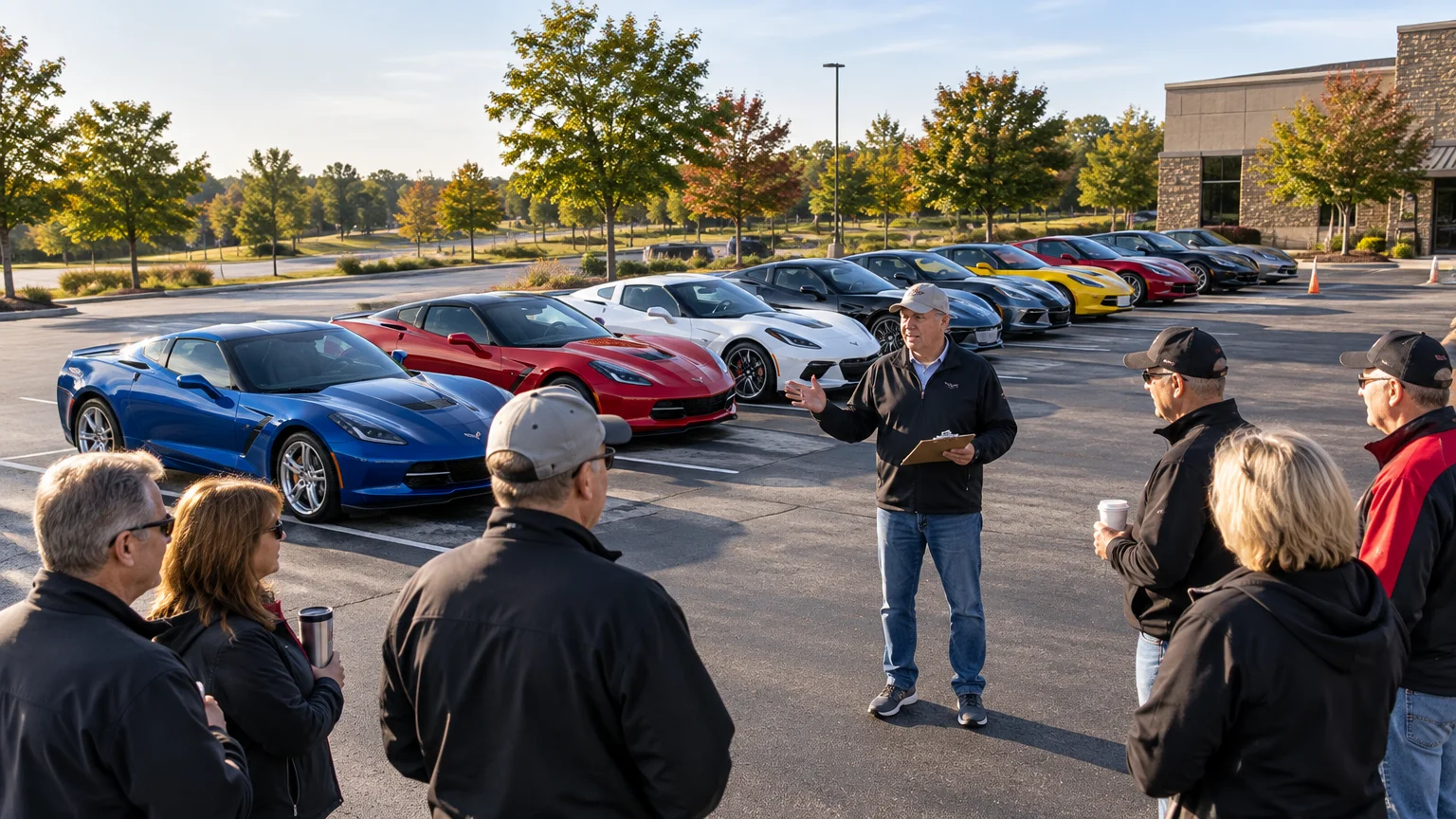
TLDR: A good Corvette club drive meeting point is approved by the property owner or manager, easy to find, large enough for the expected group, and positioned for a simple exit toward the route. It also needs room for a short driver briefing without blocking customers, fuel pumps, fire lanes, or normal traffic. Select the route and estimate attendance first; then choose the lot.
The best Corvette club drive meeting point is not necessarily the prettiest location or the place with the best coffee. It is the place where 10, 25, or 50 cars can arrive, park, receive instructions, and leave without creating confusion. When those first 20 minutes run smoothly, the whole drive feels more relaxed.
This guide focuses on a staging point for a cruise, drive-and-dine, show trip, or longer road trip. A recurring monthly meeting venue has different priorities: indoor seating, food service, presentation space, and enough time for club business. A drive staging location is mainly about vehicle circulation, route access, communication, and a clean departure.
Define the drive before choosing the parking lot
Start with the route rather than dropping a pin on a familiar parking lot. The meeting point should be on the correct side of the Indianapolis area for the direction of travel. Starting west of town for an eastbound drive, for example, adds city traffic before the enjoyable part has even begun.
Write down six details before comparing possible sites:
- Expected number of Corvettes, plus space for guests and support vehicles
- Direction of departure and the first major road on the route
- Arrival window, briefing time, and actual departure time
- Approximate drive length and whether drivers need fuel before leaving
- Need for restrooms, food, shelter, or accessible facilities
- A backup site or alternate plan for heavy traffic, severe weather, construction, or an unexpectedly full lot
Attendance affects much more than the number of parking spaces. A group of 10 can often gather in one row. A 25-car group benefits from several adjacent rows and a defined briefing area. A 50-car event may need controlled arrival lanes, multiple parking volunteers, and a departure in smaller groups. Never assume every marked space is available merely because the lot looks empty during an earlier visit.
Compare the common types of meeting points
| Location type | What it does well | What to verify |
|---|---|---|
| Dealership or repair shop | Automotive setting, recognizable address, and potentially generous parking outside business hours | Written or clearly documented approval, operating hours, customer access, alarms, gates, and restroom availability |
| Restaurant or coffee shop | Food, restrooms, and an easy social start | Manager approval, peak customer periods, minimum purchases, reserved spaces, and whether the kitchen can handle the group |
| Fuel station or travel center | Convenient fuel, snacks, restrooms, and highway access | Permission, pump traffic, truck circulation, parking limits, and a staging area away from active fueling lanes |
| Public or state park | Pleasant surroundings and possible picnic or restroom facilities | Posted rules, opening hours, designated parking, entrance fees, capacity, and any approval or event requirements |
| Destination-adjacent lot | Short final drive and useful staging before a show or tour | Whether the lot is controlled by the destination, overflow rules, opening time, and conflicts with other events |
A business that welcomes the club can be an excellent partner, but buying coffee or fuel does not automatically reserve its lot. Contact someone with authority to approve the gathering. Explain the date, arrival window, approximate car count, requested parking area, and expected departure time. Ask where drivers should park and which aisles must remain open.
Apply five tests to every candidate location
1. Confirm that the gathering is allowed
Get approval before publishing a private lot as the official starting point. For parks, visitor centers, churches, municipal lots, and destination overflow areas, identify who controls the property and ask about group use. Keep the organizer’s contact name and the agreed instructions with the event notes.
Indiana state-park visitors must use designated parking and follow posted property rules. Organized special events on Indiana Department of Natural Resources properties may also require advance approval or permitting, so organizers should contact the specific property rather than treating every park lot as open event space. The official Indiana State Parks rules and regulations are a useful starting point, but property staff should confirm how the rules apply to the planned gathering.
2. Inspect parking and circulation
Drive through the site at roughly the same day and time the club plans to use it. Look for narrow entrances, steep transitions, potholes, speed bumps, low branches, blind corners, one-way aisles, delivery traffic, and curbs that may be awkward for a low Corvette. Check whether cars can enter without backing up onto a public road.
Choose a parking area where lead and sweep vehicles can be positioned deliberately. The lead car needs a clear path to the exit. The sweep car should be able to depart last without getting trapped behind unrelated traffic. Leave fire lanes, accessible spaces, store entrances, loading zones, and fuel pumps completely open.
3. Find a safe briefing space
Drivers should not have to stand in an active travel lane to hear the plan. A good briefing area is visible from the club’s parking rows but separated from moving cars. For a large group, face drivers away from loud road traffic and keep the briefing short enough that important instructions are not lost in side conversations.
4. Check the practical facilities
Restrooms become increasingly important as the drive length and arrival window grow. Fuel availability is useful, but the group should not occupy pumps as a staging area. Also consider lighting for early departures, shelter during rain, mobile-phone reception, trash facilities, and accessible routes for members who need them.
If a state park is under consideration, verify current entrance costs and property-specific access details before announcing the event. Indiana state-park access may involve entrance fees or passes, and those details can affect both arrival time and participant expectations.
5. Test the departure
The first mile matters. A right turn onto a moderate-traffic road is generally easier to manage than an unprotected left turn across several lanes. Count the traffic signals between the lot and the first regroup point. If the group will split immediately, every driver must be able to continue independently rather than racing to keep the taillights ahead in view.
A shared route and planned regroup points are safer and more dependable than trying to preserve one unbroken line. Our guide to planning a Corvette club cruise without losing half the group explains how lead, mid-pack, and sweep roles can support that approach.
Publish more than a street address
A useful event post tells members exactly where to enter and where to park. Shopping centers and parks may have several entrances, while a mapping app can direct drivers to the wrong side of a large property. Include the property name, full address, preferred entrance, parking row or landmark, and a map pin when possible.
The same post should include:
- Arrival window, briefing time, and wheels-moving departure time
- Fuel and restroom expectations
- A link to the route that participants can load before arrival
- First regroup location and the plan for missed turns
- Late-arrival instructions, including whether late drivers should go directly to the next stop
- Lead and sweep contact information or the club’s chosen communication channel
- Weather or cancellation update method and the time of the final decision
- Any parking fee, entrance charge, purchase expectation, or property rule
For recurring drives or big charity events, organizers can use removable identifiers or custom windshield and event stickers to help parking volunteers recognize registered cars. Keep identifiers small enough that they do not obstruct the driver’s view, and do not use them as a substitute for clear arrival instructions.
Use a focused 15-minute driver briefing
A briefing is not the moment to read every turn aloud. Participants should already have the route. Use the time to explain how the group will operate and what drivers should do when normal traffic breaks up the line.
- Welcome the group and identify the lead and sweep vehicles.
- Confirm the destination, major route segments, and first regroup point.
- Remind everyone to drive independently and obey traffic signals, signs, and speed limits.
- Explain that nobody should rush a yellow light or make an unsafe turn to keep up.
- State what to do after a missed turn or separation.
- Confirm the communication channel and emergency contact.
- Identify any known construction, weather concern, or route change.
- Release cars in manageable groups if the exit cannot comfortably handle the full field.
Participants should have the route on their own phone or navigation device before the departure call. A concise communication plan involving shared routes, radios where appropriate, and lead-and-sweep roles can reduce distracting phone calls; see our Corvette cruise communication system for a fuller setup.
Make Indiana checks part of the routine
Road construction, crashes, weather, and closures can change an otherwise solid route. INDOT directs travelers to its travel-information resources and 511IN for current traffic and road-condition information. Check those resources during planning and again shortly before departure.
Season matters too. Fall color can bring extra traffic to scenic roads and parks, while early spring may expose pavement damage or debris. If autumn scenery is the goal, combine the staging plan with the route and timing considerations in our Indiana fall Corvette drive guide.
Add a simple vehicle-readiness reminder
A mixed-generation Corvette group should not receive one universal tire-pressure number. Chevrolet directs owners to the tire-and-loading information label at the driver door for the specified cold tire pressure and loading information on the individual vehicle. Encourage each participant to follow the owner information for that Corvette rather than copying another member’s setup.
- Arrive with enough fuel for the planned first leg
- Check vehicle-specific cold tire pressure and visible tire condition
- Check relevant fluids according to the vehicle’s owner information
- Load the route before departure and bring a charging cable
- Carry identification, emergency contact information, and necessary medication
- Secure loose items in the cabin and cargo areas
Worked example: an 18-car Sunday drive-and-dine
Imagine a fictional 18-car drive leaving the Indianapolis area for lunch in southern Indiana. The organizer expects several couples, two first-time participants, and a mix of Corvette generations.
The club receives permission to use a specified outer row of a business lot from 8:30 to 9:15 a.m. Cars enter through the east driveway and park nose-out in two rows. The lead vehicle stages closest to the approved exit; the sweep vehicle parks at the rear. Restrooms are available, but participants are asked to arrive fueled because the lot’s pumps are not part of the staging area.
The event post lists an 8:30–8:50 arrival window, an 8:50 briefing, and a 9:05 departure. Every driver receives the route link beforehand. A public stop about 35 minutes into the route serves as the first regroup point. Anyone arriving after 9:05 proceeds there rather than trying to catch the caravan.
The organizer checks current road information the evening before and again that morning. If the original lot is unexpectedly unavailable, a previously approved backup location is sent through the event’s update channel. If severe weather makes the drive unsuitable, the group converts the outing to lunch only or reschedules instead of improvising on the road.
Avoid the failures that create a stressful start
Most meeting-point problems are predictable. Vague instructions send cars to different corners of a large lot. Missing permission creates conflict with a business. Parking around fuel pumps blocks customers. A verbal-only route leaves separated drivers without a plan. An untested exit divides the group at the first light.
The most damaging mistake is creating pressure to keep up with the lead car. A club drive is not a convoy with special rights, and a meeting point cannot compensate for an unrealistic route plan. Give every driver the information and permission to proceed safely, even when the group becomes separated.
Choose the start only after you know the drive
A strong Corvette club drive meeting point fits the headcount, departure direction, schedule, and needs of the people attending. Secure property approval, inspect the lot at the intended time, test the exit, and check current Indiana road information. Then publish every essential detail in one shareable event post.
That preparation may not be the glamorous part of organizing a Corvette drive, but it gives the group something valuable: a calm start, a clear plan, and more attention left for the road and the people enjoying it together.