
TLDR
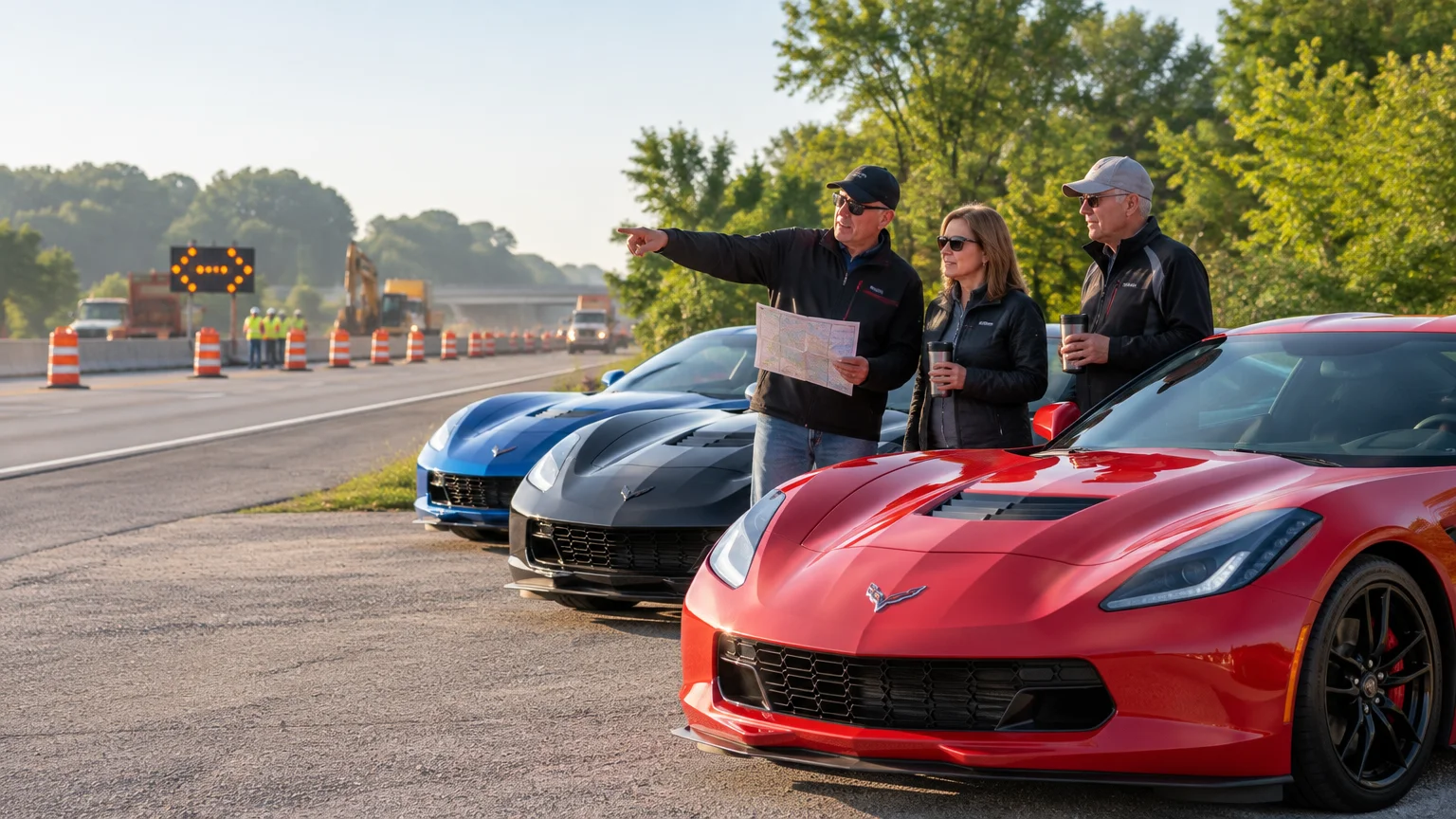
For an Indiana road construction Corvette cruise, check official project information while planning, review live conditions shortly before departure, pre-run the route, and give every driver the route plus an alternate. Choose legal regroup points instead of expecting the cars to remain in one unbroken line. If a closure, rough detour, severe delay, or unsafe condition defeats that plan, shorten, reroute, delay, or cancel the drive.
Construction season does not have to end the club-driving season. It does mean the organizer needs more than a scenic route and a lunch reservation. The best plan assumes lane closures may split the group, navigation apps may choose different detours, and a road that looked fine two weeks ago may have changed by Saturday morning.
Start an Indiana road construction Corvette cruise with two checks
Treat route research as a two-stage job. During early planning, use INDOT project information to identify current and upcoming work along the main route and alternate. INDOT says its construction map can help motorists locate current and upcoming transportation projects. This is the time to reject a road with a major project, investigate likely detours, or move a stop before the itinerary goes to members.
Then check live conditions close to departure. INDOT identifies 511IN traveler information as a resource for traffic speeds, road conditions, cameras, construction information, and other events affecting travel. Review it the evening before the cruise and again before the drivers’ meeting. A final check should complement the route pre-run, not replace it.
Do not rely on one volunteer’s phone once the cars are moving. Every participant should receive the destination address, main route, alternate route, planned stops, regroup locations, and a contact number. That allows a separated driver to continue calmly rather than making a sudden lane change to catch the Corvette ahead.
Build a route plan that can survive separation
A construction-aware itinerary should work even when the convoy does not. Indiana traffic lights, entrance ramps, lane reductions, and work zones will eventually divide a large group. The goal is not to prevent every separation; it is to make separation routine and low-pressure.
| Plan element | What to confirm | Why it matters |
|---|---|---|
| Main route | Current restrictions, surface condition, turns, stop access, and destination entrance | Shows whether the preferred drive is suitable for the cars and group size |
| Tested alternate | Driveable roads, legal turns, clearance concerns, and realistic travel time | Prevents navigation apps from scattering drivers across unknown shortcuts |
| Regroup points | Legal entrance, enough parking, safe exit, and clear location details | Lets separated cars reconnect without roadside waiting |
| Fuel and rest stop | Hours, restroom availability, parking capacity, and approach direction | Avoids squeezing a club group into an unsuitable property |
| Lead and sweep roles | Contact method, route copy, departure procedure, and responsibilities | Places informed volunteers at both ends of the group |
| Go/no-go triggers | Closures, severe weather, unsafe surfaces, excessive delay, or lost stop access | Makes the final decision consistent rather than emotional |
For broader convoy planning, use the system in how to plan a Corvette club cruise without losing half the group. If the starting location itself is still unsettled, confirm capacity, permission, entrances, and safe departure flow with the club-drive meeting-point checklist. Construction can make a normally easy parking lot difficult to enter from one direction, so the approach matters as much as the address.
Pre-run both the main route and the alternate
A map can show a closure, but it cannot always tell you how a low or carefully maintained Corvette will experience the road. A pre-run can reveal pavement milling, loose material, abrupt lane shifts, temporary ramps, steel plates, deep transitions, confusing signs, backed-up construction traffic, or an awkward entrance into the lunch stop.
Drive the proposed route near the same time of day as the event when practical. Traffic around an active project can feel very different on a weekday afternoon than on a Saturday morning, but even an imperfect rehearsal can expose bad turns and unsuitable stops. Record actual travel time without trying to maintain an ambitious pace.
During the pre-run, inspect every regroup point from a group-arrival perspective. Can several Corvettes enter without blocking traffic? Is there enough room to park without interfering with the business? Can the lead car leave in the correct direction without asking the entire group to make a difficult turn? Obtain permission when the stop is private property and the group will occupy meaningful space.
The National Corvette Museum’s 2024 Caravan guidance described pre-runs, planned stops, reform locations, route information, grouping by driving style or generation, and traveling at the pace of the slowest car. Those are sensible principles for a local drive too, especially when construction adds uncertainty.
Give the drivers a compact, usable itinerary
A good route sheet is not a turn-by-turn novel. It is a recovery tool. Put the date, departure time, destination address, primary route, alternate, numbered regroup points, fuel stop, lead and sweep contacts, and any known construction note on one concise handout or mobile document.
Send the same information before the event so members can load the destination and stops into their preferred navigation app. At the drivers’ meeting, explain which route controls if an app disagrees and what participants should do when separated. A simple rule works well: follow traffic law, continue toward the next named regroup point, and never take a risky action just to preserve the line.
For recurring club events, route cards can be paired with numbered club windshield stickers or event identifiers so volunteers can recognize registered cars at the start and regroup stops. Keep identifiers out of the driver’s sightline, and do not let event materials become a substitute for distributing the actual route.
Communication should be similarly simple. The lead and sweep need a dependable way to exchange essential updates, but drivers should not be managing complicated messages in traffic. A shared itinerary, defined roles, and planned reform points do more useful work than a frantic chain of calls. The Corvette cruise communication system offers a practical framework for routes, radios, lead and sweep roles, and regrouping.
Set work-zone rules before the cars move
A drivers’ meeting should make one point unmistakable: no one is expected to catch up inside a work zone. INDOT advises motorists to research the route, pay attention to signs, move into the open lane when appropriate, maintain distance, and slow down. It also identifies following too closely, unsafe lane movement, inattention, and unsafe speed as common factors in work-zone crashes.
- Obey posted signs, signals, flaggers, lane controls, and speed limits.
- Leave enough space for changing traffic and rough or uneven pavement.
- Merge legally and predictably rather than blocking lanes to keep the group together.
- Do not wave another Corvette through a turn when that driver cannot independently confirm it is safe.
- If separated, continue to the next designated stop instead of waiting on a shoulder.
- Let non-club traffic enter and leave the line normally.
- Report a problem to the sweep when safely parked, not while improvising in moving traffic.
These rules may spread the cars over a few miles, and that is fine. A cruise is still a club event when members arrive at the next stop in smaller clusters. It stops being enjoyable when drivers feel pressure to beat a light, crowd a merge, or follow too closely.
Use a model-neutral Corvette departure check
A mixed-generation club should avoid giving one blanket technical specification to every driver. Tire-pressure targets, warning systems, controls, and clearance vary by model year, equipment, tires, and modifications. Each owner should follow the applicable Chevrolet documentation and tire guidance for that vehicle.
- Check tire condition and set pressures according to the vehicle’s applicable guidance.
- Begin with enough fuel for the route, alternate, and a reasonable delay.
- Load the destination and regroup points before leaving the starting lot.
- Bring a charged phone and the organizer’s contact information.
- Secure loose cabin and cargo-area items.
- Consider the needs of lowered cars, splitters, low-profile tires, or other modifications during route selection.
- Tell the organizer privately about any range, mobility, or vehicle concern that affects stop planning.
- Bring suitable seasonal supplies, including water or weather gear when conditions call for them.
The organizer does not need to inspect every car or act as its mechanic. The useful club role is to publish the route demands honestly. If the pre-run found rough pavement, a steep driveway, limited fuel access, or a long section without services, tell members before they commit.
Know when to reroute, shorten, delay, or cancel
Create decision triggers before the morning of the cruise. That removes the temptation to continue simply because everyone has already polished the cars and arrived at the starting point.
Reroute
Use the tested alternate when a primary-road closure, major backup, unsafe pavement transition, or inaccessible stop affects only one portion of the drive. Announce the change to everyone before departure whenever possible.
Shorten
Remove an optional scenic loop when construction delays would cause the group to miss a reservation, arrive after a venue closes, or spend most of the day in traffic. A shorter drive with time to visit is usually better than an overstuffed itinerary.
Delay or cancel
Delay or cancel when neither route has been verified, severe weather compounds work-zone hazards, legal regroup stops are unavailable, official restrictions make the route impractical, or the destination can no longer receive the group. Make the decision early enough for participants to adjust their plans.
Make calm logistics part of the fun
The successful construction-season cruise is not necessarily the one that keeps every Corvette together from the first turn to the last. It is the one where drivers know the plan, understand how to recover from separation, and arrive without feeling rushed.
Start by checking INDOT project information, drive the proposed route and alternate, choose two or three dependable regroup points, and distribute the complete itinerary. Then check live conditions before departure and use the go/no-go triggers you already agreed upon. That little bit of discipline leaves more attention for the roads, the cars, the destination, and the people who made the drive worth organizing.