TLDR: A reliable Corvette cruise communication system is not a single radio, app, or phone feature. It is a shared route, designated lead and sweep cars, planned regroup points, and short radio messages reserved for information that drivers actually need. Send the details before departure so nobody must conduct a rolling committee meeting from behind the wheel.
For most club drives, start with a route link and a simple written backup. Put an FRS handheld radio in each car when practical, choose one channel before departure, and identify the lead and sweep drivers. Phones remain useful for navigation and parked follow-up, but they should not be the primary tool for announcing every turn or chasing a car that gets separated.
The system matters more than the gadget
A line of Corvettes attracts attention, but it is still a collection of individual vehicles moving through ordinary traffic. Stoplights change. Trucks enter the road. A driver may miss an exit or need fuel sooner than expected. Trying to preserve an unbroken line can encourage abrupt lane changes, speeding, and unnecessary distraction.
The better goal is not “keep every Corvette bumper together.” It is “make sure every driver knows the route, the next safe regroup point, and what to do when the group separates.” That principle should guide the entire communication plan.
Organized Corvette travel is hardly unusual. The National Corvette Museum runs guided Museum in Motion driving tours, and its caravan material has instructed participants to bring FRS or GMRS radios for communication. National Corvette Museum driving tours provide useful context for how established Corvette travel can become when routes and group logistics are planned in advance.
What each communication tool should do
| Need | Primary tool | Backup | Operating rule |
|---|---|---|---|
| Route and turn guidance | Pre-shared navigation route | Printed route summary | Every car must be able to finish independently. |
| Immediate turn or road warning | Short two-way-radio message | Navigation display | Announce only information drivers can act on safely. |
| Separated vehicle | Continue to the next regroup point | Call or message after parking | Never pressure the driver to catch up. |
| Mechanical or medical problem | Clear emergency radio message | Phone call from a safe, stopped location | Sweep reports the issue; other cars avoid creating a roadside crowd. |
| Arrival and parking | Radio instructions from the parking coordinator | Pre-shared parking note | Give lane or entrance details before cars reach the venue. |
No tool has to do everything. Navigation handles the route better than a running radio commentary. Radios handle immediate, one-to-many updates better than a chain of calls. Phones are best for detailed conversations once the appropriate person is safely parked.
Corvette infotainment is not a convoy network
The phrase Corvette cruise communication system can also sound like a question about Bluetooth, Apple CarPlay, or Android Auto. Those features can support compatible phone functions and navigation through the vehicle’s infotainment system, but they do not automatically connect every Corvette in a caravan. Chevrolet advises owners to consult vehicle-specific information because compatibility and available features can vary.
Use the car’s built-in system for the individual driver’s navigation and permitted hands-free functions. Use the club’s operating plan for car-to-car coordination. Before the cruise, drivers should confirm their own Corvette’s controls while parked rather than trying to learn menus after the group starts moving.
Choose between FRS, GMRS, and phones
FRS handheld radios
FRS handhelds are a practical baseline for a local dinner run, scenic drive, or show caravan because the organizer can distribute compatible radios and test them together. Real-world reception changes with terrain, buildings, vehicle spacing, and equipment, so never promise that a radio will cover the entire route. The route and regroup plan must still work when a transmission does not.
GMRS operation
GMRS can be considered when a club wants a more formal radio setup, but licensing cannot be treated as a club-wide umbrella. Federal rules require an individual GMRS license and specify who may operate under it, including the licensee’s immediate family members. One member’s license does not simply cover a caravan full of unrelated drivers. Organizers considering GMRS should review the current FCC rules for individual GMRS licensing rather than relying on old forum posts or assumptions.
Cell phones and group chats
A group chat is excellent before departure. It can carry the route link, start location, weather update, fuel stop, organizer contact, and last-minute cancellation notice. It is poor as a live convoy channel because messages invite drivers to read, type, or manage notifications.
Indiana’s hands-free law prohibits drivers from holding mobile devices while driving and permits hands-free technology such as Bluetooth and headsets. INDOT’s Hands-Free Indiana guidance explains the state rule. Permission to use hands-free technology does not make a long conversation wise: NHTSA identifies visual, manual, and cognitive forms of distraction and notes that hands-free use does not eliminate all distraction.
Assign lead, sweep, and support roles
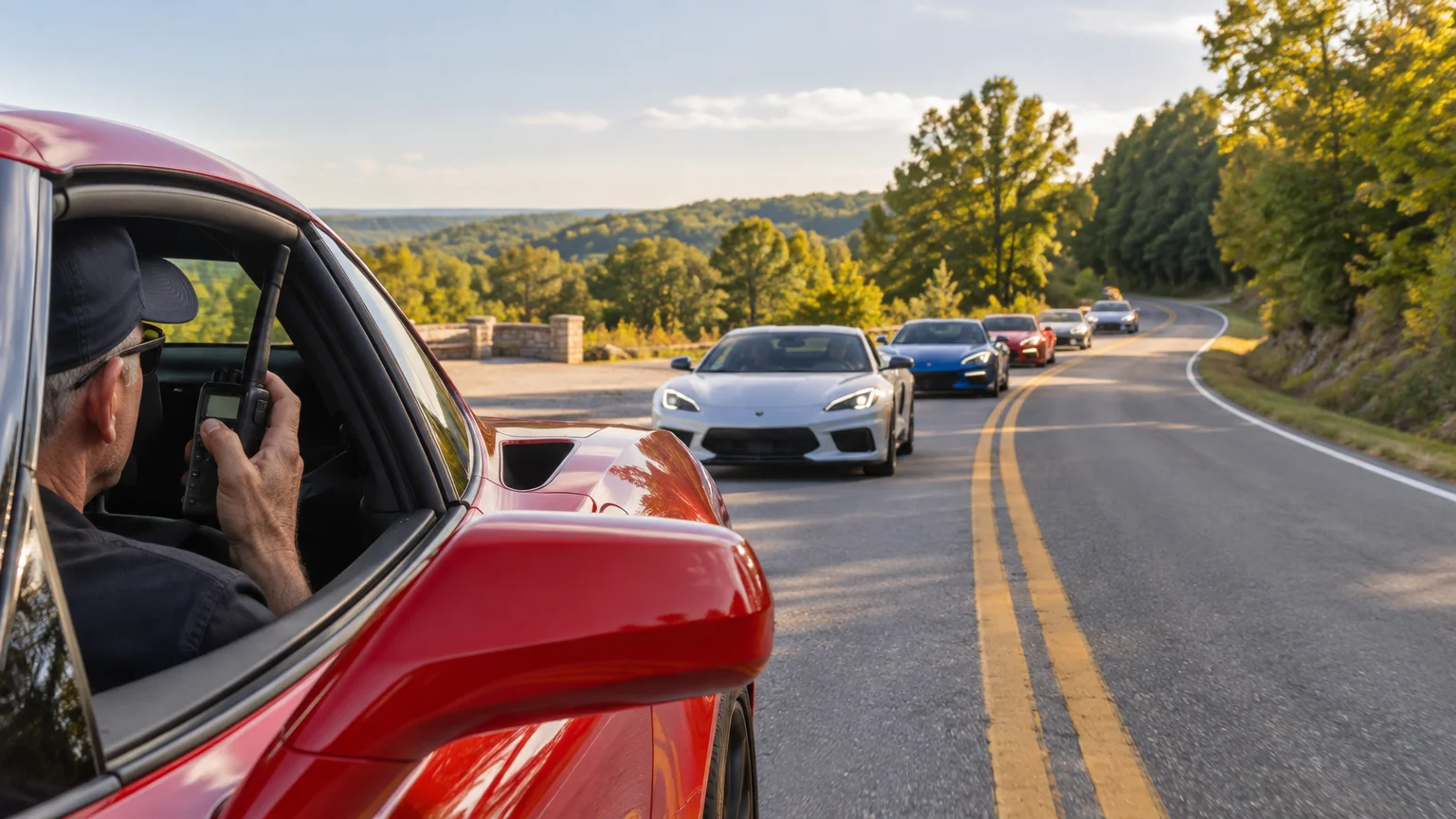
The lead car sets a lawful, predictable pace and announces major turns, hazards, and planned stops. The lead driver should not spend the cruise solving every individual problem. If possible, a passenger handles the radio and checks route notes.
The sweep car stays at the back of the planned group, reports separation or trouble, and confirms when the final car clears a turn. Sweep is not responsible for herding everyone into a tight formation. If a car has a mechanical problem, sweep can report it and stop when safe while the lead takes the remaining group to an appropriate regroup location.
A larger caravan may benefit from smaller pods, each with a pod leader. There is no magic car count because urban traffic, rural roads, visibility, and driver experience all matter. When the lead can no longer receive useful reports from the rear—or when one traffic-light cycle routinely splits the group—it is time to consider smaller units following the same route.
Communication works best when it supports a sound route. For the broader planning process, see how to plan a Corvette club cruise without losing half the group. Indiana organizers planning a seasonal outing can also use the route and stop considerations in this Indiana fall Corvette drive guide.
Use a short radio protocol
Radio messages should be plain, specific, and brief. Say who needs the information, what is happening, and what action is expected. Pause after pressing the transmit button, speak normally, and release it when finished.
- “All cars: right turn at the next stop sign.”
- “Sweep to lead: three cars held at the light. We will continue on the route.”
- “Lead to group: gravel near the right side of the lane.”
- “Car eight to sweep: warning light on. I am pulling into the next safe lot.”
- “Parking team to group: use the second entrance and follow the cones.”
Avoid constant sightseeing commentary, jokes that block the channel, and vague calls such as “turn here.” Do not broadcast an instruction to run a yellow light, block an intersection, speed up, or make an unsafe maneuver. Radio channel settings sometimes described as privacy settings should not be treated as confidential communication; keep personal and sensitive details off the air.
Brief every driver before departure
A five-minute parking-lot briefing can prevent an hour of confusion. Keep it focused on decisions drivers may need to make without contacting the leader.
- Send the route link early enough for drivers to open and review it.
- Provide a short written backup listing major roads, stops, and destination addresses.
- Mark fuel, restroom, meal, and regroup locations.
- Identify lead, sweep, and any pod leaders by name and Corvette description.
- Set and test the radio channel before engines start.
- Check batteries, charging cables, mounts, and spare power.
- Explain that separated cars continue safely to the next regroup point.
- Agree on a mechanical-problem and emergency procedure.
- Confirm the destination entrance and current parking instructions.
- Tell drivers that traffic laws and safe judgment take priority over staying together.
Test every radio from inside the cars, not just while people are standing together in the parking lot. A mismatched channel or setting is much easier to fix before departure. The organizer should also repeat any route revision verbally and update the written or digital route whenever time allows.
A worked example for a 15-car Indiana cruise
Imagine 15 Corvettes leaving the Indianapolis area for a relaxed scenic drive. The organizer sends a navigation link two days ahead and provides a one-page summary at check-in. The summary names the destination, major roads, a fuel stop, and two regroup locations with enough room for the cars.
The group uses tested FRS handhelds as its live communication baseline. Car one leads, car 15 sweeps, and a reliable driver near the middle monitors both ends. If the route includes several traffic lights, the organizer may divide the field into three five-car pods rather than trying to push all 15 cars through each signal cycle.
When six cars miss a green light, sweep reports the split. Lead continues at the normal pace and waits at the first planned regroup location. Nobody makes a U-turn, stops on a shoulder merely to preserve the line, or speeds to close the gap. If one driver misses a turn completely, that driver follows navigation to the regroup point and contacts the organizer only after reaching a safe place to stop.
Plan for the failures that happen most often
- Dead radio battery: carry spare power and rely on the route rather than passing a phone around.
- Mismatched settings: run a roll call before departure and after a long stop.
- Lost reception: continue to the next scheduled regroup point.
- Too much chatter: reserve the channel for route, hazard, separation, mechanical, and parking information.
- Missed exit: continue safely and let navigation recalculate; never reverse or stop in a travel lane.
- Weather change: lead announces the next safe stop, where the group can decide whether to shorten or cancel the route.
- Last-minute detour: stop the group somewhere appropriate and distribute the revised route instead of improvising complicated directions over the radio.
The best system makes the drive feel easier
A good Corvette cruise should feel social at the start, enjoyable on the road, and relaxed when everyone arrives. It should not depend on constant calls, an uninterrupted line of cars, or one organizer remembering every detail in real time.
For the next drive, choose the route and regroup points first. Then appoint lead and sweep, distribute and test radios, and brief everyone on what to do if the group separates. That simple Corvette cruise communication system keeps the information flowing while leaving each driver’s attention where it belongs: on the road and on the pleasure of driving the car.
References
- Museum in Motion – National Corvette Museum
- Arizona & New Mexico – 2024 Caravan – National Corvette Museum
- Smartphone Integration | Vehicle Support | Chevy
- www.chevrolet.com
- eCFR :: 47 CFR 95.1705 — Individual licenses required; eligibility; who may operate; cooperative use.
- INDOT: Hands-Free Indiana
- Distracted Driving | NHTSA