
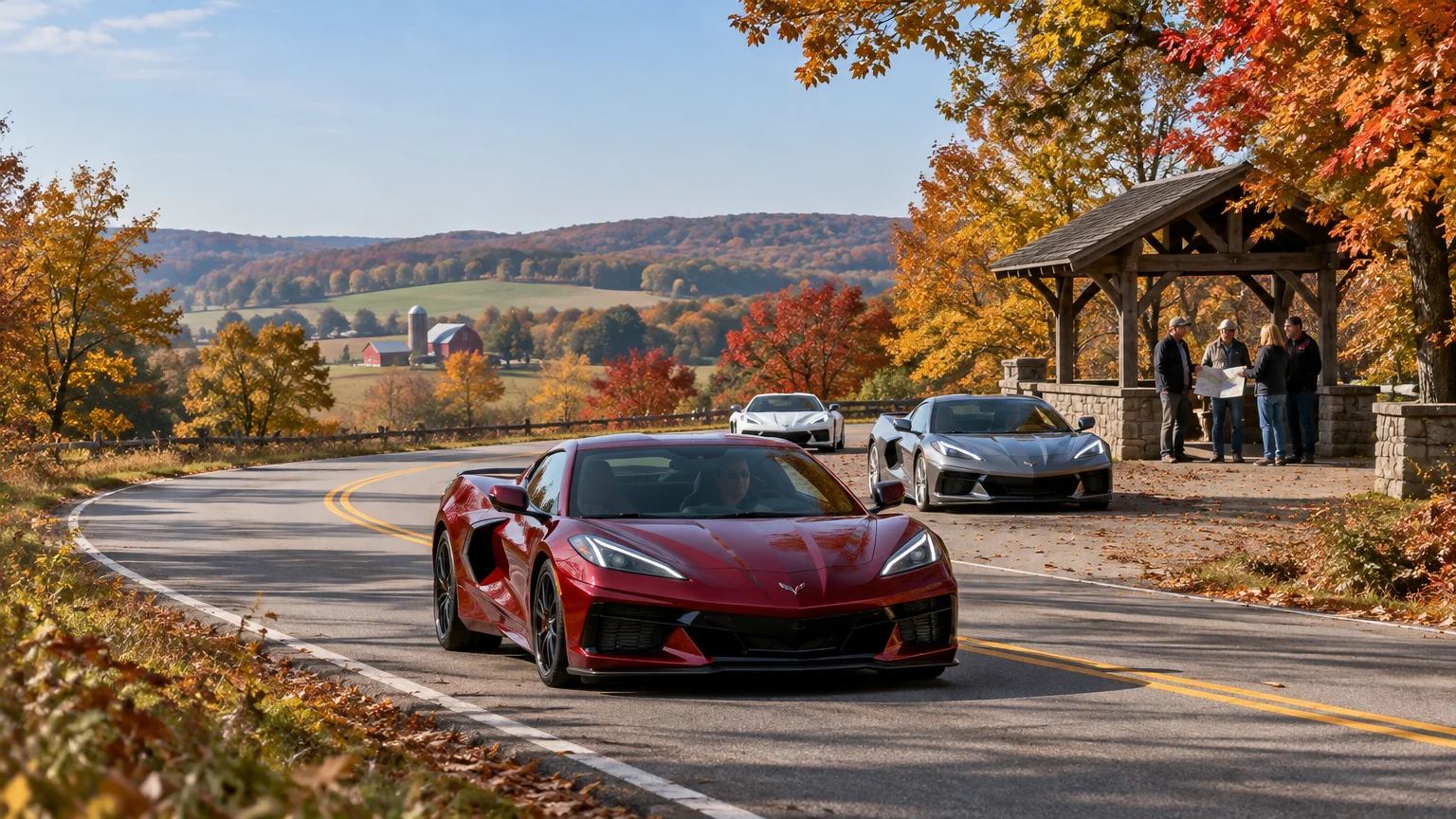
TLDR: Plan an Indiana fall Corvette drive around one scenic region, a comfortable lunch or destination stop, and two or three reliable regroup points. Check every road for construction, surface concerns, traffic, and low-clearance trouble shortly before departure. Give every driver the route and rain plan, then judge the day by how much the group enjoys it—not by miles covered.
A great Indiana fall Corvette drive does not need the longest route or the twistiest road. It needs colorful scenery, pavement that suits the participating cars, enough parking, and a pace that leaves room for conversation. Pick one area, create a simple loop or point-to-point route, and keep the moving portion manageable.
Indiana offers several useful starting points. INDOT’s scenic-byway network includes the Ohio River, Hoosier Hills, Whitewater Canal, Wabash River, Historic Michigan Road, and Lincoln Highway routes. A scenic designation makes these roads worth investigating, but it does not guarantee that every segment is ideal for a lowered Corvette or a long convoy. Review Indiana’s official scenic-byway network, then inspect the specific route you intend to use.
Choose the kind of fall drive before choosing roads
Start with the experience you want members to have. A compact drive-and-dine outing calls for different roads and timing than a weekend along the Ohio River. Once the event format is clear, unnecessary miles become much easier to remove.
| Drive format | Good fit | Planning priority |
|---|---|---|
| Central or southern Indiana day loop | A mixed group that wants to return home the same day | A convenient starting point, moderate mileage, and one dependable meal stop |
| Ohio River weekend | Drivers who want longer scenic stretches and an overnight social event | Lodging, fuel, luggage capacity, and flexible arrival times |
| Whitewater Canal outing | A group interested in small towns and frequent stops | Parking capacity, pedestrian activity, and shorter driving segments |
| Brown County-area drive | Members prioritizing fall scenery and a destination lunch | Early arrival, crowd avoidance, and alternate parking |
| Covered-bridge or festival outing | Drivers who enjoy local history and seasonal activity | Traffic control, rough approaches, parking, and a plan to explore on foot |
Visit Indiana features Brown County and the Ohio River Scenic Byway in its seasonal foliage and road-trip material, making both reasonable regions to investigate. Fall color does not arrive on one dependable statewide date, however. Conditions vary by region and weather, so treat foliage forecasts as planning guidance rather than a promise.
For a group leaving the Indianapolis area, I would favor a route with one clear destination rather than a sprawling tour of every scenic road nearby. A good pattern is a 60- to 90-minute morning leg, an unhurried stop, lunch, and a different return leg if conditions permit. That gives the day shape without turning it into an endurance run.
Make the route suitable for Corvettes, not just colorful
A road can look wonderful on a tourism map and still be a poor group choice. Narrow shoulders, gravel entrances, abrupt driveway transitions, broken pavement, standing water, and crowded roadside pull-offs matter more when several Corvettes arrive together.
Review the route in short segments and ask practical questions:
- Are the roads paved throughout, including entrances to lunch and photo stops?
- Could a low front splitter scrape at a driveway, railroad crossing, parking ramp, or steep bridge approach?
- Can every car enter and leave a stop without backing into busy traffic?
- Is there enough parking for the expected group without occupying reserved or customer-only spaces?
- Are fuel and restrooms available before the group genuinely needs them?
- Will wet leaves, shaded corners, fog, or standing water create avoidable risk?
- Can the route accommodate a driver who prefers a relaxed pace?
- Is there a simple bypass if one segment becomes congested or closed?
Scout the route close enough to the event that your observations remain useful. If an in-person scouting run is not practical, combine current mapping imagery with direct calls to the restaurant and destination. Ask about pavement, entrances, parking restrictions, seasonal hours, and any construction nearby. Do not assume that ten open spaces on a satellite image will still be available on a busy October Saturday.
Prepare each Corvette for cool and changeable weather
Owners should use the manual for their specific model year when checking tire, maintenance, and operating guidance. Chevrolet provides manuals and guides by year, make, and model, which is more reliable than applying one generation’s recommendations to every Corvette. Find the correct Chevrolet owner’s manual and guides.
Before departure, drivers should check tire condition and pressure when appropriate, fluid levels, exterior lights, wipers, fuel level, and the condition of the battery if the car has been driven infrequently. Pack the wheel-lock key if the car uses one, along with a charging cable, basic cleaning towels, any model-appropriate tire mobility equipment, and required medications.
Cool mornings can become warm afternoons, while shaded roads may remain damp long after open pavement dries. Drivers should leave more space than they would on a clear summer cruise and avoid treating the group drive as a performance event. Fallen leaves can obscure potholes or reduce grip, especially when wet.
Build a group plan that survives separation
Traffic lights and ordinary vehicles will split a convoy. That is not a planning failure; expecting a long line to remain unbroken is. Every participant should be able to reach the next stop without seeing the Corvette ahead.
Give drivers a destination address, major road list, planned stops, and the route captain’s contact information before departure. A digital route is convenient, but a one-page printed summary remains useful when a phone loses service, overheats, runs low on power, or sends a driver toward the wrong entrance.
Use an experienced lead car and a dependable sweep car. The lead sets a legal, predictable pace. The sweep confirms that nobody has been stranded or left behind. Neither role should require aggressive driving, blocking intersections, or asking participants to run a changing light. For a deeper operating plan, use this guide to planning a Corvette club cruise without losing half the group.
Keep the drivers’ meeting brief and specific
- Introduce the lead and sweep drivers and identify their cars.
- State the next destination, not merely the name of the road.
- Point out the first fuel, restroom, and regroup locations.
- Explain that nobody should speed or make an unsafe pass to catch up.
- Ask drivers to signal early and leave room for non-group traffic.
- Confirm the procedure for a breakdown, missed turn, or route change.
- Give the time and location for the final gathering if drivers become separated.
For a larger turnout, divide the cars into smaller groups with separate leads rather than stretching one convoy across several miles. Stagger departures by a few minutes and bring everyone together at a destination with adequate capacity. The drive will feel calmer, and local traffic will have more room to move around the group.
Use a two-stage planning checklist
| When | Route captain | Each driver |
|---|---|---|
| About 48 hours before | Check Indiana 511, weather, destination hours, parking, restaurant count, and fuel stops. Send the confirmed route and backup plan. | Review the route, fuel the car, consult the model-specific manual, and report any change in attendance. |
| Morning of the drive | Check Indiana 511 and weather again. Contact stops if group size changed. Brief the lead and sweep drivers. | Check tires, lights, fluids, wipers, phone charge, and required personal items. Arrive with enough fuel. |
| At departure | Conduct the drivers’ meeting, distribute route backups, and leave on schedule. | Save destination addresses, listen to the briefing, and avoid last-minute fueling. |
| During the drive | Monitor conditions, make route changes only when necessary, and communicate them clearly at a safe stop. | Drive at a comfortable legal pace and continue to the next known regroup point if separated. |
Indiana 511 reports planned construction, crashes, closures, weather events, road conditions, and traffic that may affect a trip. Check it during the planning stage, again roughly 48 hours before departure, and once more on the morning of the drive. Conditions can change after any check, so the alternate route still matters. Check current Indiana 511 event information.
Plan stops as carefully as the route
The lunch stop is where a pleasant drive can unravel. A restaurant that handles four couples easily may struggle when 20 people arrive together. Call ahead with a realistic attendance range and ask whether the group needs a reservation, limited menu, separate checks, or staggered seating. Confirm where the cars may park and whether another event is expected that day.
Photo stops require the same care. Choose a paved lot where cars can enter in small groups without stopping on the roadway. Avoid an improvised roadside lineup, no matter how good the trees look. If you want a formal display, secure permission from the property manager and identify where ordinary visitors should park.
Busy festivals deserve special handling. Driving a convoy into the center of a crowded event can create delays, difficult parking, pedestrian conflicts, and rough detours. A better plan may be to meet at an approved lot outside the busiest area, park together if permission allows, and walk or use available local transportation. Festival dates and traffic plans are time-sensitive, so verify them for the year of the drive rather than copying last season’s schedule.
Expect the common autumn failure points
Late departure is the first problem. It pushes the group into lunch crowds and reduces daylight for the return. Publish an arrival time and a wheels-moving time, then leave as scheduled. Drivers running late should have the first destination address so they can meet the group safely.
The second problem is trying to preserve the original route after conditions change. If rain, congestion, roadwork, or an incident makes the scenic segment unpleasant, use the simpler alternative. A shorter drive followed by a good meal is better than forcing a wet, stressful route merely because it appeared on the invitation.
The third problem is overprogramming. Three scenic stops, two attractions, lunch, shopping, and 200 miles may look exciting on paper, but the group will spend the day watching the clock. Leave room for conversations, photos, restroom delays, and the inevitable discussion about wheels, exhausts, and which generation has the best rear view.
A sensible rain plan protects the social part of the day
Set the rain decision process before inviting the group. Depending on the forecast, the route captain might delay departure, shorten the drive, switch to major roads, move directly to lunch, or reschedule. Name the communication channel and decision time so members are not searching through several message threads before sunrise.
Light rain does not automatically cancel every outing, but the route should match the conditions and the comfort level of participating drivers. Heavy rain, poor visibility, flooding concerns, thunderstorms, or unsafe road conditions are good reasons to change the plan. No member should feel pressured to expose a car—or themselves—to conditions they would rather avoid.
Plan the day people will want to repeat
The best Indiana fall Corvette drive has a simple recipe: one scenic region, Corvette-friendly pavement, clear regroup points, a welcoming destination, and enough flexibility to handle autumn weather and traffic. Choose the format first, inspect the route carefully, and give every driver the information needed to travel independently.
Your next step is to select one scenic area and draft a route with no more than three essential stops. Check Indiana 511, call the lunch location, identify a paved backup route, and recruit lead and sweep drivers. When the day arrives, keep the pace relaxed and enjoy why everyone brought the cars out in the first place: colorful roads, good company, and another Corvette story worth sharing.