
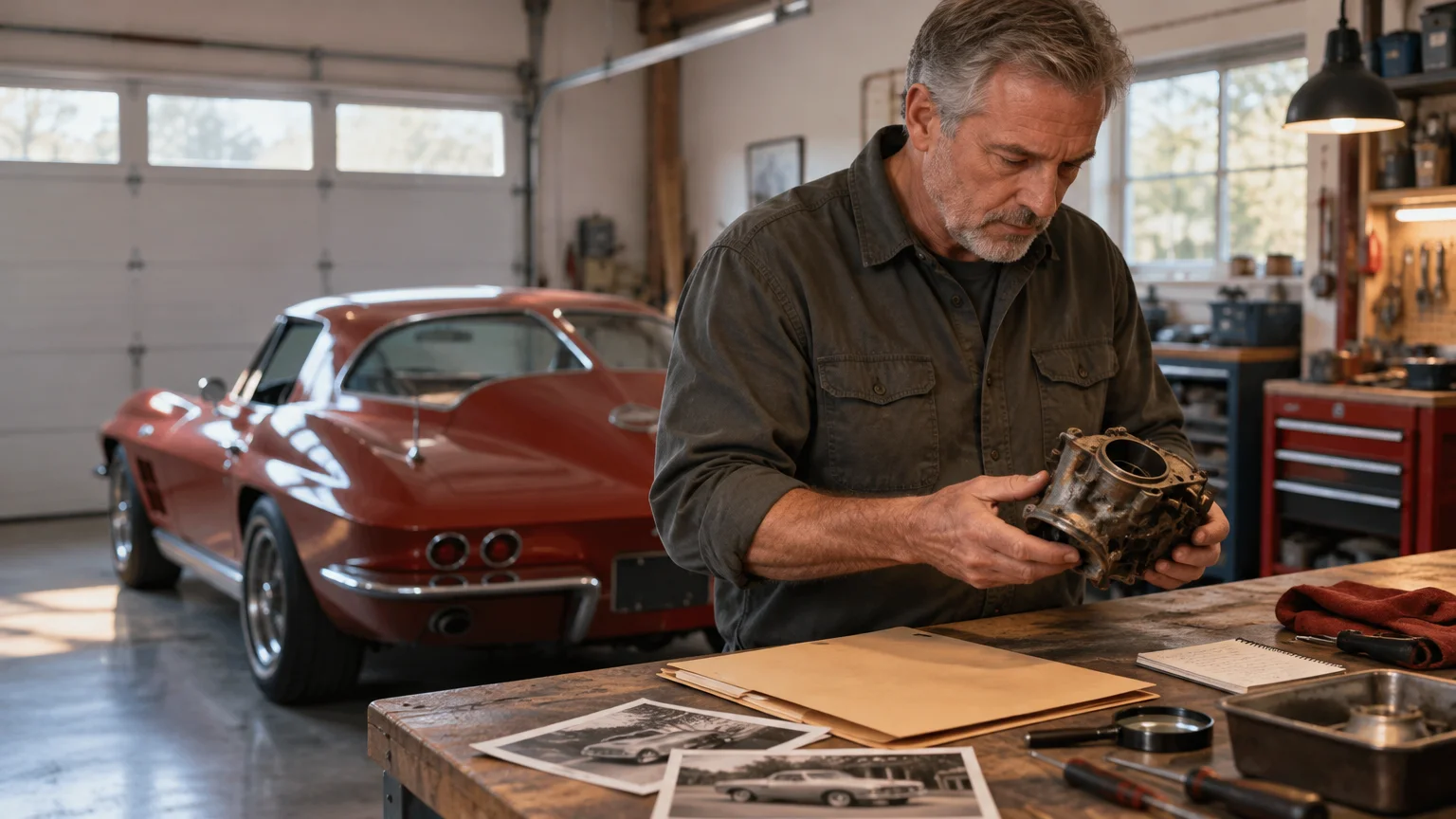
TLDR: To research original Corvette equipment, begin with the exact model year and VIN, collect car-specific paperwork where available, photograph the vehicle before taking anything apart, and compare its components with year-specific factory and specialist references. No single casting number, label, receipt, or old-looking part proves the entire car is original. Build a case from several pieces of evidence.
The most important step when you research original Corvette equipment is deciding what you are actually trying to establish. “Original to this car,” “factory-correct,” “numbers-matching,” and “OEM replacement” are different conclusions. Keeping those claims separate will help you make a better purchase, preserve a survivor, plan a sensible restoration, or prepare for an originality-oriented show without replacing good parts unnecessarily.
Start by defining what “original” means
Corvette conversations can become confusing because owners use the same word for several different ideas. Before inspecting parts, establish the standard that matters for your project.
- Original to the car: The component is believed to be the same physical part installed when that particular Corvette was assembled.
- Factory-correct: The part number, configuration, finish, dimensions, and date range are appropriate for the model year or assembly period, but the part may not have come on this car.
- Numbers-matching: Certain identifying numbers or stampings are consistent with the vehicle. This phrase needs qualification because it does not automatically cover every component.
- OEM or OE replacement: A component supplied by the original manufacturer or through its service network. It may be functionally correct without being an assembly-line part.
- NOS: New old stock, generally meaning an unused period service part. Age and packaging alone do not establish that it matches a particular Corvette.
- Reproduction: A newly manufactured part intended to resemble or replace an original component. Reproduction quality and accuracy can vary considerably.
A driver, a preserved survivor, and a judged restoration can all be excellent Corvettes. They simply call for different decisions. A reliable modern replacement may be the right answer for a frequently driven car, while preserving a worn but identifiable component may matter more on an unusually intact survivor.
Choose the objective before buying parts
Write down the purpose of your research in one sentence. Are you evaluating a car before purchase, documenting it before a repair, preserving surviving factory equipment, or returning it to a documented configuration? This prevents a common and expensive mistake: ordering parts before understanding what is already on the car.
For a purchase, concentrate on whether the seller’s claims are supported. For preservation, concentrate on recording untouched finishes, fasteners, markings, routing, and component relationships. For restoration, identify the best-supported factory configuration while recording every known deviation. For a road-going club car, distinguish historical decisions from safety and reliability decisions; originality should not become an excuse to ignore a failing component.
Document the Corvette before disassembly
An old component can be researched after removal, but its location, orientation, neighboring fasteners, and connection to the rest of the car may be much harder to reconstruct. Dirt, overspray, sealant, clips, shims, and fastener patterns can all provide context. Cleaning first and photographing later may erase part of the story.
Create a folder labeled with the model year and VIN. Give each area of the car its own subfolder, such as engine compartment, interior, chassis, body, suspension, fuel system, and paperwork. Include a note in a photo when the location is not obvious.
- Photograph all four sides, the interior, engine compartment, cargo area, underside, wheels, and visible suspension before work begins.
- Take both wide views and readable close-ups of tags, stampings, labels, casting marks, part numbers, paint traces, hose routing, and fasteners.
- Record the VIN and any engine, transmission, axle, frame, body, or trim identifiers relevant to that model year.
- Scan purchase paperwork, dealer documents, window stickers, build sheets, service invoices, registrations, owner correspondence, and old photographs.
- Write down where each loose document or removed component came from. A part without location context is less useful as evidence.
- Retain replaced components when practical and lawful, especially identifiable housings, tags, brackets, dated glass, carburetors, distributors, radios, wheels, and trim.
- Do not aggressively sand, polish, restamp, repaint, or chemically strip an identifier merely to make it easier to read. Start with non-destructive inspection and careful lighting.
Use an evidence hierarchy
The strongest conclusion usually comes from agreement among factory documentation, paperwork plausibly connected to the car, and physical evidence. Treat each source according to what it can genuinely establish.
| Evidence | What it can support | What it cannot prove by itself |
|---|---|---|
| Car-specific factory record | The equipment or configuration recorded for an identified vehicle | That every component currently fitted is the original physical part |
| Build sheet, dealer invoice, or window sticker tied to the VIN | How the car was documented or sold when new | That no equipment was changed after delivery |
| Undisturbed label, tag, or stamping | Identity, codes, or equipment information within that label’s model-year context | Whole-car originality or the authenticity of unrelated components |
| Part number, casting number, and date code | Whether a component is plausible for the application and assembly period | That the component was installed on this exact car at the factory |
| Old photographs and service records | Ownership history, configuration at a particular date, and known repairs | The car’s precise assembly-line configuration unless supported elsewhere |
| Model-year factory literature | Available equipment, specifications, and general production information | Which optional equipment one particular car received |
| Judging guide or specialist reference | Expected parts, finishes, markings, and date-code interpretation for a defined year range | An unbroken chain of ownership for an individual component |
| Seller statement or forum post | A lead that tells you what to investigate | A final originality conclusion without supporting evidence |
Research original Corvette equipment in layers
1. Identify the car precisely
Record the complete VIN exactly as it appears on the car and paperwork. Confirm the stated model year, body style, engine claim, and other basic identity details using references appropriate to that generation. Do not assume the decoding method, label location, or component-stamping convention from one generation applies to another.
Also look for signs that an identifier has been disturbed: mismatched fasteners, fresh sealant, unusual grinding, inconsistent characters, or a tag area that looks different from the surrounding material. Those signs are reasons for closer examination, not automatic proof of fraud. Repairs, corrosion work, collision damage, and prior restoration can all alter an area.
2. Establish what was available for that model year
The GM Heritage Vehicle Information Kits library includes Corvette material beginning with the 1953 model year. These kits can help establish model-year specifications and available equipment. GM also describes its broader archive as containing build documentation, dealer invoices, and/or build sheets for almost all GM cars and trucks beginning with the 1977 model year, but that statement does not guarantee an individual record for every VIN.
Use model-year material to create a list of plausible engines, transmissions, colors, trim, wheels, convenience equipment, emissions equipment, and other relevant options. That list establishes possibilities. It does not establish what your particular car received.
3. Search for records connected to the individual car
Look for a build sheet, dealer invoice, window sticker, warranty material, Protect-O-Plate where applicable, service records, and old ownership photographs. Match VINs, dates, dealer details, addresses, and equipment descriptions across documents. A convincing paperwork trail is internally consistent rather than dependent on one attractive document.
When a record is unavailable, say so in your notes. An evidence gap is not proof that the car is wrong. It simply limits how confidently you can describe it.
4. Inspect the physical evidence as a system
Check part numbers, casting numbers, assembly dates, stampings, finishes, fasteners, routing, and configuration together. A casting date that reasonably precedes vehicle assembly may support plausibility, but production timing varies by component and era. A date that looks right cannot establish that the part has remained with the car since new.
Study relationships as well as individual marks. Does the transmission type agree with the controls and surrounding hardware? Do accessory brackets, pulleys, wiring, cooling equipment, and emissions components form a coherent model-year configuration? Has one apparently correct part been surrounded by later adaptations? These questions often reveal more than one isolated number.
5. Interpret labels within their model-year context
Labels can be valuable, but their names, locations, layouts, and purposes change. GM’s 1986 Corvette material says the Service Parts Identification label identified vehicle equipment, including regular production options and standard or mandatory options, and that it was applied at the assembly plant. GM’s 2005 Corvette material similarly says the label can help identify original parts and options. That does not mean every older Corvette has the same label or that one decoding procedure works across generations.
Depending on year, your research may involve VIN information, paint and trim codes, RPO codes, engine or transmission identifiers, axle information, tire labels, emissions labels, casting dates, and component part numbers. Use a reference written for the exact model year whenever possible.
6. Consult a year-specific specialist reference
The National Corvette Restorers Society offers year-range-specific judging guides and technical resources addressing details such as finishes, part numbers, casting numbers, and date-code interpretation. NCRS also publishes judging information and score-sheet resources, which can help an owner understand how an originality-oriented evaluation is structured.
A guide is most useful when paired with the evidence on your car. Editions and interpretations can change, so confirm that a resource covers the exact year and configuration under investigation. For a major purchase or high-cost restoration decision, ask a knowledgeable marque specialist or experienced judge to inspect the car in person.
Avoid the most common originality traps
- Old-looking is not the same as original. A weathered component could have been installed decades after the car was built.
- Factory-correct is not the same as original to this car. A properly dated replacement may be ideal for a restoration without being the assembly-line component.
- One matching date is not conclusive. Check identifiers, configuration, finish, and the relationship to the vehicle’s assembly period.
- A numbers-matching engine claim does not prove that the transmission, axle, paint, interior, glass, wheels, or accessories are original.
- An OEM service part is not automatically an assembly-line part. Service replacements may use revised numbers, designs, markings, or finishes.
- A reproduction document or label should never be used to create a false ownership history. Clearly record replacement tags, decals, and paperwork in the project file.
- Restoration work can destroy evidence. Photograph, measure, and record before blasting, machining, repainting, or replacing anything.
Turn the research into a decision
Finish with an equipment worksheet containing four columns: component, observed evidence, best-supported conclusion, and planned action. Use restrained conclusions such as “consistent with the model year,” “documented on dealer invoice,” “believed original to the car,” “known service replacement,” or “origin not established.” Those phrases are more informative than declaring an entire Corvette original.
Then choose an action for each item: preserve it, service it without cosmetic restoration, replace it for reliability while retaining the old part, source a factory-correct replacement, or investigate further. Record modifications that make the car safer or more enjoyable. Honest documentation lets a future owner understand the decision instead of having to rediscover it.
A club tech day can be particularly useful for this work. One person can photograph while another reads markings, checks references, and records locations. Membership also creates access to accumulated knowledge; the practical benefits of a Corvette club often include meeting owners who recognize generation-specific details and know when a question needs a specialist.
Build the folder before the next project
You do not need a concours restoration plan to benefit from originality research. A well-organized photo and document folder helps with repairs, purchase inspections, insurance discussions, show preparation, parts ordering, and future ownership history. Start before the next repair or cleanup session: photograph the car as it sits, scan the paperwork you already have, and list the questions that remain.
The goal is not to force every Corvette back to a single standard. It is to know what the evidence supports, preserve information before it disappears, and make deliberate choices. That approach respects an untouched survivor, an accurately restored show car, and a thoughtfully upgraded Indiana driver alike.