TLDR: Build a Corvette club dealer partnership around one useful pilot event, not an open-ended sponsorship request. Define what the dealer provides, what the club handles, and where sales activity stops. Put costs, branding, insurance, attendee information, weather decisions, and charitable funds in writing. After the event, renew only if members received real value and both parties met their commitments.
The strongest Corvette club dealer partnership does not make members feel as though they drove into a three-hour commercial. It gives them something they already want: trusted technical information, a convenient gathering place, support for a charity project, a better-organized cruise-in, or a clearly documented ownership benefit.
Start small. Ask a local Chevrolet dealer to help with one defined event or a short pilot calendar. A successful technical night or charity cruise-in creates evidence that the relationship works. A vague request for money, discounts, and year-round support creates questions neither side can answer.
What a useful partnership looks like
A dealer relationship should improve the ownership experience without controlling the club calendar. The club keeps authority over its membership, communications, event standards, and choice of activities. The dealer decides what space, staff time, equipment, merchandise, or financial support it can commit.
That exchange can be valuable on both sides. A club may provide organized attendance, volunteers, event promotion, owner feedback, community visibility, and people who understand how to behave around special vehicles. A dealer may provide a venue, service expertise, parking support, door prizes, refreshments, or a written member offer. None of those benefits should be assumed. Each belongs in the proposal and final agreement.
Corvette clubs have room for more than parking-lot shows. The Indiana Region profile for Circle City Corvette Club describes activities including rallies, parades, fundraising, drive-and-dines, car shows, and longer trips. That variety is a useful reminder: a dealer should support the club’s broader community rather than redefine it as a source of sales leads.
| Partnership model | Best use | Dealer contribution | Club contribution | Main guardrail |
|---|---|---|---|---|
| Meeting-space partner | Monthly meeting or planning session | Approved room, parking area, access times, and site contact | Attendance estimate, room setup, conduct, and cleanup | Do not let every meeting become a mandatory sales presentation |
| Event host | Cruise-in, send-off, or seasonal gathering | Venue, restrooms, parking plan, and agreed event support | Registration, volunteers, traffic flow, promotion, and cleanup | Document capacity, weather policy, and permitted commercial activity |
| Service education partner | Maintenance seminar or model-specific technical night | Qualified presenter, demonstration space, and defined topic | Questions in advance, member communication, and timekeeping | Keep education separate from individual diagnoses and high-pressure selling |
| Charity-event partner | Fundraiser, toy drive, or benefit cruise-in | Venue or in-kind support under agreed terms | Volunteers, beneficiary coordination, and transparent donation handling | Name who receives, safeguards, counts, and transfers funds |
| Member-benefit partner | A defined parts, service, or event benefit | Written eligibility, exclusions, duration, and redemption process | Accurate member verification and clear communication | Never advertise a discount, allocation, or priority that is not documented |
Choose the first request carefully
The most realistic first request is usually specific and operational: host a 90-minute Corvette care seminar, provide a starting location for a Saturday cruise, contribute two door prizes, or make part of the lot available for a charity cruise-in. These requests are easier to evaluate than “Will you sponsor our club?”
Match the request to a genuine need. If members have been asking about seasonal maintenance, propose a technical session. If the club needs a safe departure point, first determine whether the dealership lot has suitable access, restrooms, staffing, and permission for the expected number of cars. Our guide to choosing a starting point for a large club drive covers the practical site questions that still apply when a dealer hosts.
Ask for cash only when there is a clear budget and purpose. A $300 request tied to event insurance, portable restrooms, or a charity contribution is easier to understand than an unrestricted sponsorship request. In-kind support may be more useful for a first event, but it should still be assigned a scope. “Dealer provides refreshments for up to 60 registered attendees” is much clearer than “dealer handles food.”
Build a one-page Corvette club dealer partnership proposal
A busy dealership representative should be able to understand the opportunity in a few minutes. Keep the opening proposal to one page and move detailed operating terms into an event agreement after both sides show interest.
- Club overview: Explain who participates, the geographic area served, and the kinds of ownership or community activities the club organizes. Do not inflate membership or attendance.
- Defined project: Propose one event or a limited six-month pilot calendar. Include the purpose, preferred date, backup date, approximate hours, and anticipated location.
- Attendance basis: Give a realistic range based on comparable club events or current registrations. Label a new-event estimate as an estimate.
- Exact request: State the requested space, staff time, technical presenter, prize, refreshments, printing support, or financial amount.
- Club deliverables: List promotion, registration, volunteers, parking control, member communication, setup, and cleanup responsibilities.
- Decision process: Identify one club contact and one dealership contact, the date by which approval is needed, and who can authorize changes.
- Follow-up: Promise a short recap with attendance, funds raised where applicable, participant feedback, photographs approved for use, and lessons for the next event.
Do not lead with social-media reach unless the club can document it and it matters to the project. Organized volunteers, dependable communication, and a clean parking lot at the end of the day are often more persuasive than a large but loosely defined audience.
Put the important boundaries in writing
Friendliness is not a substitute for an agreement. A short written plan protects the club volunteer who changes roles, the dealership manager who gets transferred, and the members who need to know what kind of event they are attending.
- Scope and schedule: Record the event purpose, location, access time, public hours, expected attendance, included spaces, and each party’s named coordinator.
- Money and property: Identify every cash or in-kind contribution, payment date, purchasing responsibility, equipment owner, and process for handling damage or unspent funds.
- Names, logos, photographs, and data: Approve how each logo may be used, who can photograph attendees, where images may appear, and whether attendee information will be collected. Club registration data should not quietly become a sales list.
- Vehicle activity: Separate static displays, owner parking, test drives, repair demonstrations, appraisals, and any offer to sell. State who supervises each activity and who may participate.
- Risk and disruption: Assign responsibility for insurance confirmation, parking control, weather monitoring, cancellation, security, cleanup, charitable donations, and emergency communication.
The National Corvette Museum’s club guidance identifies basic and event insurance as organizational considerations, while its car-show program also gives clubs a route for submitting shows to its calendar. Organizers can review the National Corvette Museum car-show information while remembering that listing or inviting an organization does not replace local approvals or suitable coverage.
Keep Indiana sales rules separate from the car show
A dealer displaying a Corvette is not necessarily conducting a sale, but the planned activity matters. Indiana’s Auto Dealer Services Division states that a dealer may not sell or offer to sell a vehicle away from its established business location without an off-site sales permit. It also says applications must be received at least 10 business days before the sales event and that temporary locations must comply with local ordinances and zoning requirements.
Indiana describes a separate exemption for motor-vehicle-industry-sponsored trade shows when the sponsor notifies the Division at least 30 days beforehand. A club should not assume its cruise-in qualifies for that exemption. The dealer should review the planned activities against the state’s current off-site sales requirements and confirm any local venue rules.
The simplest club policy is to describe the event accurately and leave regulated sales decisions to the licensed dealer. If vehicles are only displayed, say so. If test drives, appraisals, deposits, or offers are contemplated, raise those details early rather than adding them on event morning.
A worked example: Spring Corvette Care and Charity Cruise-In
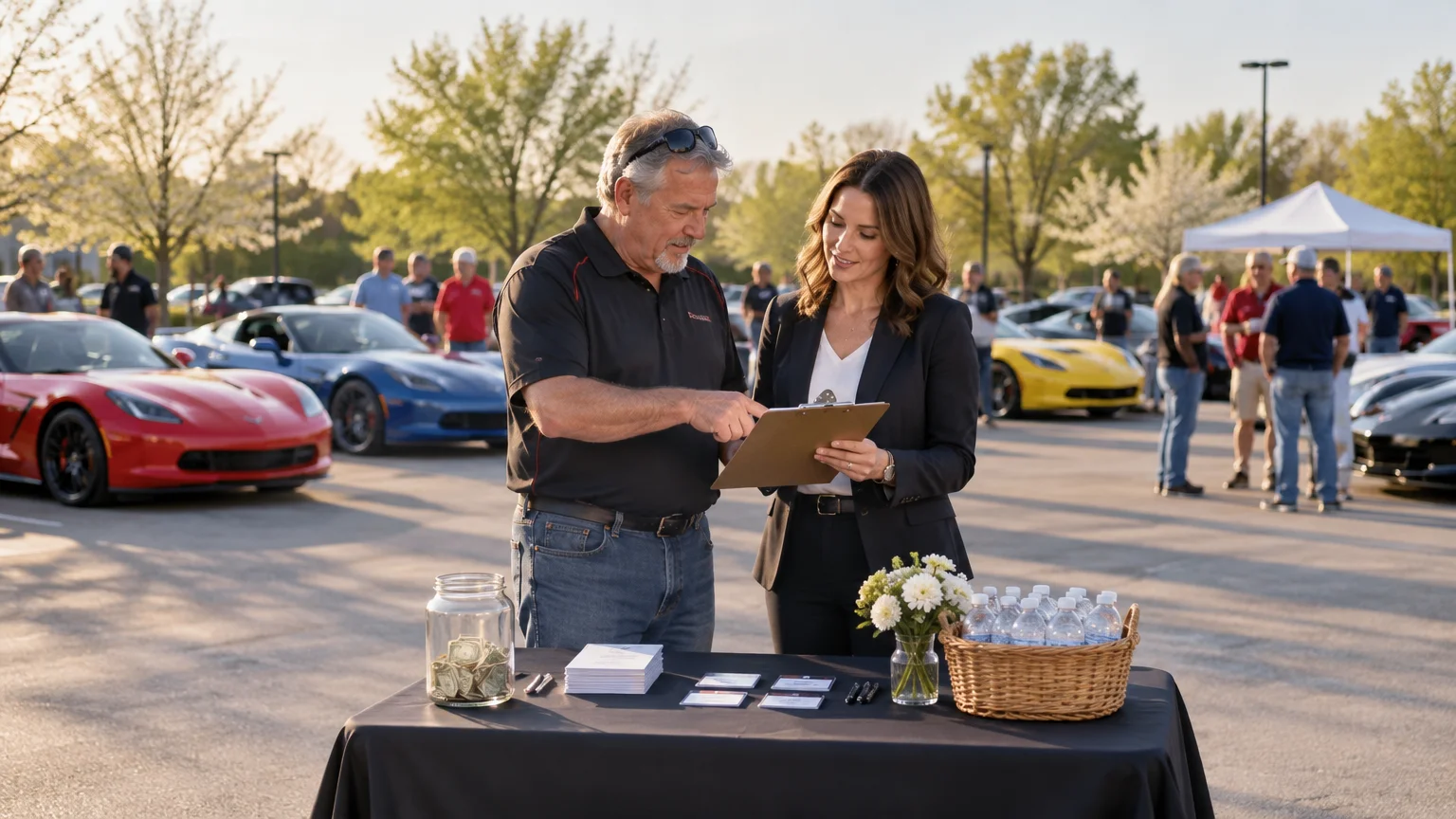
Imagine a club wants a useful spring gathering before driving season. It proposes a Saturday morning event at a local Chevrolet dealership with three elements: a 30-minute seasonal-care presentation, a parked Corvette display, and collection of sealed goods for a named community organization.
The dealer agrees to provide an approved section of its lot, restroom access, one qualified service presenter, four traffic cones, and coffee for registered guests. The club handles advance registration, two parking volunteers, the display layout, charity coordination, event reminders, and cleanup. One representative from each side has authority to make weather decisions by 6 p.m. Friday.
The agreement says the service session is general education, not diagnosis of individual cars. Dealer staff may answer questions after the presentation, but attendee contact details will not be shared without express permission. Any sales conversations remain dealer-managed and separate from club registration. The charity provides written instructions for accepting and transferring donations.
If a short club drive follows, the cruise needs its own route, lead and sweep drivers, regroup points, and departure briefing. A dealership host does not solve group-driving logistics. Use a tested process for planning a Corvette club cruise rather than expecting a long line of cars to stay together automatically.
This event works because every contribution serves the attendee. Members learn something, enjoy the cars, support a community organization, and can leave without sitting through a sales presentation. The dealer receives appropriate recognition and a chance to demonstrate expertise without taking over the gathering.
Avoid the partnership failures that erode trust
Most weak partnerships do not fail because either side had bad intentions. They fail because broad promises were never translated into operating details.
- A vague sponsorship ask: Replace “support our club” with one project, one request, and one decision date.
- Inflated turnout: Give a range with a basis. Separate registrations from expected arrivals and expected arrivals from total public traffic.
- Undocumented benefits: Do not announce a service discount, parts price, vehicle allocation, ordering priority, or recurring perk until the dealer supplies written terms and exclusions.
- Unapproved branding: Obtain permission before putting the dealer’s name or logo on shirts, signs, decals, trophies, registration pages, or social posts.
- Hidden lead generation: Tell attendees what information is collected, why it is needed, who receives it, and whether marketing consent is optional.
- Unclear exclusivity: If the dealer expects to be the only automotive sponsor, define the category, geographic reach, media, events, and term. Broad exclusivity can prevent the club from accepting unrelated help.
- Assumed insurance: Each party should confirm its own coverage and any certificates required for the venue or activity. Do not assume the dealership’s policy automatically covers club volunteers or every activity.
- No rain or cancellation plan: Set the decision time, decision-maker, backup date, refund treatment, and communication channels before promotion begins.
Measure the pilot before renewing it
Attendance matters, but it is not the only useful measure. Review whether the event started on time, parking worked, volunteers had clear jobs, the promised support arrived, members found the program useful, and the property was left in good condition. For a fundraiser, record what was collected and when it reached the beneficiary.
Ask members two short questions: “What was useful?” and “What should change?” Ask the dealer whether staffing and costs matched expectations. Then record any complaints about sales pressure, privacy, access, or unclear benefits. A smaller event that members trust is a better foundation than a crowded event they will avoid next year.
The relationship is worth renewing when it makes Corvette ownership or community participation better and the workload remains sustainable. If the dealer mainly wants leads or the club mainly wants money, say so and reconsider the fit. A partnership should be reciprocal without making every interaction transactional.
Start with one event members will appreciate
Choose one practical project, assign one decision-maker on each side, and write down the boundaries before publishing the date. A technical night, charity cruise-in, or well-managed drive departure gives both parties a manageable way to learn.
Afterward, share a concise recap and decide whether to repeat, revise, or stop. That measured approach produces something far more valuable than a dealer logo on every flyer: a local relationship that helps Corvette owners gather, learn, drive, and contribute without feeling as though the club has become an advertisement.