
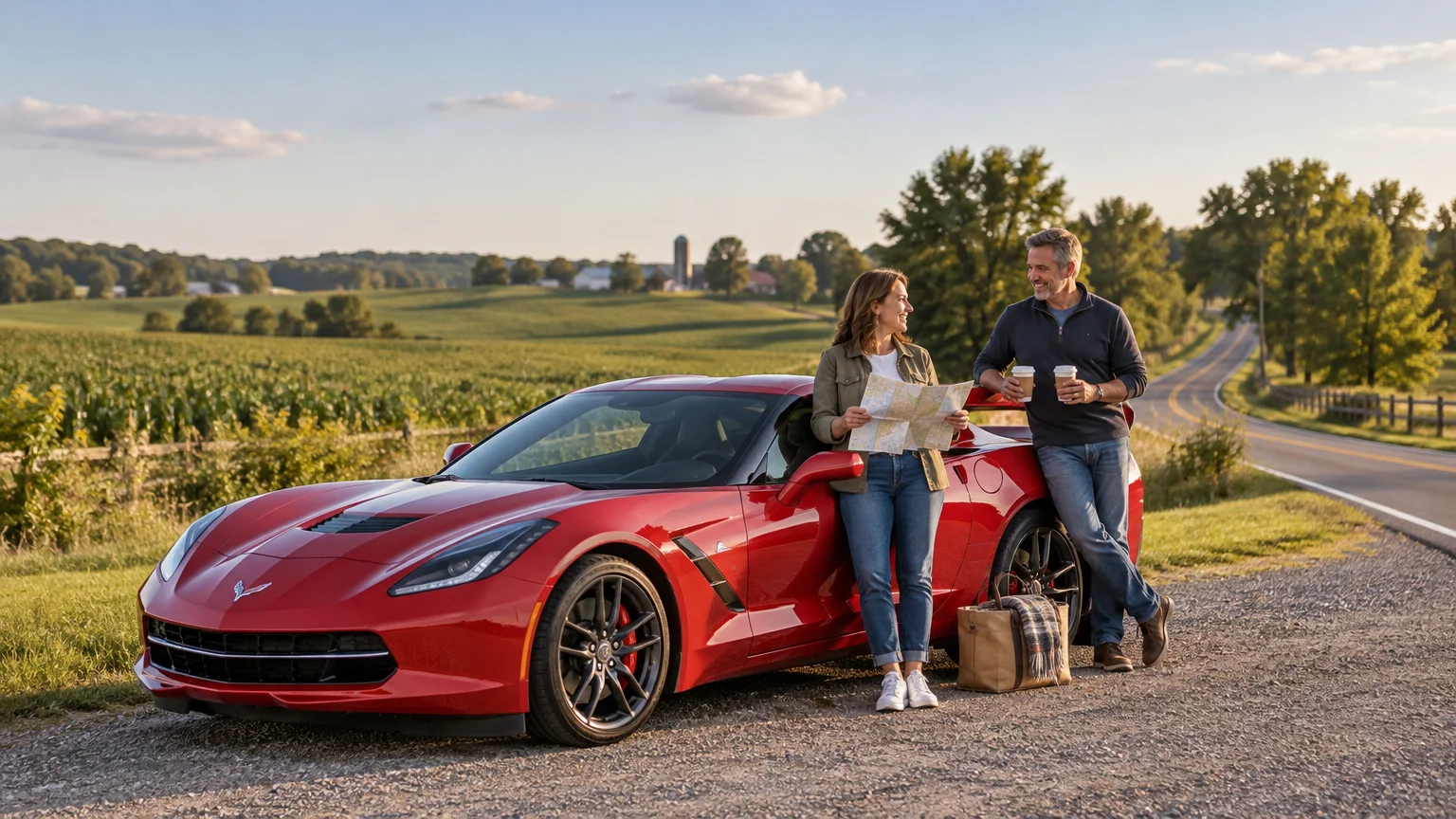
TLDR: Do not try to turn your spouse into a car person. Build Corvette outings around something you can both enjoy, such as a good restaurant, an easy scenic drive, photography, local history, charity work, or time with friends. Keep the first outing short, explain the plan in advance, and make it easy to leave early. Successful Corvette hobby family participation gives each person a genuine reason to attend without requiring equal enthusiasm for the car.
A Corvette may be the reason an outing begins, but it does not have to be the only subject once you leave the driveway. That distinction matters when your spouse or partner does not care about option codes, production totals, detailing products, or the difference between two exhaust settings. The goal is not to deliver a rolling technical seminar. It is to create a day that happens to include the Corvette.
The most sustainable approach to Corvette hobby family participation is to offer more than one way to belong. One person may love driving. Another may enjoy planning lunch, taking photographs, meeting people, volunteering, or exploring a destination. All of those contributions count.
Start With Their Interests, Not Your Corvette
Instead of asking, “Do you want to go to a Corvette show?” ask a more useful question: “Would you enjoy a scenic drive followed by lunch at that place we have been meaning to try?” The second invitation explains what is in the day for both people.
Think about what your spouse already likes. A gardener may enjoy a drive ending at a public garden. A photographer might welcome an early-morning stop at a covered bridge. Someone interested in local history may prefer a museum or historic downtown. A social person may like a relaxed cruise night but dislike a judged show where owners stay beside their cars for hours.
That is not disguising a Corvette event. It is designing a shared outing honestly. Tell your spouse how much driving is involved, how long the stop will last, whether food and restrooms are available, and whether leaving early is practical.
Offer Three Ways to Participate
Most family-friendly Corvette activities fit into three broad lanes: drive, experience, and contribute. A person can choose one lane, move between them, or simply come along as a guest.
| Participation lane | What it can include | Good fit for |
|---|---|---|
| Drive | Ride along, choose music, navigate, select stops, or share driving when appropriate | Someone who enjoys travel more than car talk |
| Experience | Visit a restaurant, museum, festival, scenic overlook, shop, or historic site | Someone motivated by the destination |
| Contribute | Take photos, greet guests, manage check-in, collect donations, set up food, or help with cleanup | Someone who likes having a useful role |
The contribution lane is especially valuable. Standing in a parking lot while owners discuss tires can feel isolating. Greeting arriving families, photographing cars, arranging raffle items, or helping at a charity table creates a natural way to meet people and participate without pretending to be fascinated by every mechanical detail.
Choose a Low-Pressure First Outing
An all-day judged show is rarely the best introduction for a reluctant spouse. It can involve an early arrival, limited shade, uncertain food, and long periods when an owner feels obligated to remain with the car. A performance event can be even less welcoming if the guest is unfamiliar with its schedule, noise, safety rules, or spectator areas.
Start with a short drive-and-dine, casual cruise night, picnic, charity collection, or museum visit. Aim for two to four hours rather than an entire day. Pick a destination with comfortable seating, restrooms, and something to do beyond looking at cars. Our collection of Corvette club event ideas offers several formats that can work for people with different interests.
Set expectations before leaving. Explain where the group meets, when it departs, how long the drive should take, and what happens if the weather changes. Most importantly, agree that either person can suggest heading home without turning it into a referendum on the hobby.
Build a Passenger-Friendly Indiana Drive
A fun driver’s road is not automatically a fun passenger’s road. Repeated hard acceleration, abrupt braking, tightly packed caravans, and long stretches without a restroom can make a passenger count the minutes until the day ends. Smooth driving and predictable stops usually create a better shared experience.
INDOT identifies several Indiana scenic byways, including the Historic National Road, Indiana’s Historic Pathways, the Ohio River Scenic Byway, the Whitewater Canal Scenic Byway, and the Wabash River Scenic Byway. These are planning inspiration, not ready-made club itineraries. Organizers still need to verify current construction, road conditions, parking capacity, operating hours, and suitable stops before leading a group. INDOT also publishes map resources that can provide a current starting point for route research.
If multiple Corvettes are traveling together, give every driver the route and destination instead of depending on an unbroken line of cars. Use planned regroup points and allow normal traffic to move through the group. Our guide to planning a Corvette club cruise without losing the group covers the communication and regrouping details. During roadwork season, also review the steps for checking Indiana construction before a Corvette drive.
A workable 75-mile drive-and-dine example
- Meet at 9:00 a.m. in a large, approved parking area with restrooms or nearby facilities.
- Hold a five-minute briefing covering the destination, approximate mileage, regroup points, weather plan, and contact numbers.
- Leave at 9:20 for a relaxed 25- to 35-mile leg on verified roads.
- Stop for 20 minutes at a coffee shop, park, or photo location with adequate parking.
- Continue to a lunch destination that accepts the expected group size.
- End the official outing after lunch. Offer an optional return loop for anyone who wants more driving.
The optional loop is the key. A spouse who has had enough can go home after lunch, while enthusiastic drivers can add another hour. Nobody has to be the person who “cuts the day short.”
Give Your Spouse a Real Role, Not Busywork
Some people enjoy an event much more when they know why their presence matters. Ask rather than assign. Your spouse might prefer taking candid photographs, welcoming first-time guests, keeping a list of raffle winners, choosing the lunch stop, or creating the road-trip playlist.
For a show or charity event, useful roles can include check-in, hospitality, donation collection, auction support, parking guidance, food coordination, and cleanup. Be specific about the time commitment. “Could you help at check-in from 9:00 to 10:00?” is far more inviting than “We could use help all day.”
Respect a no. Participation offered under pressure usually becomes resentment with a club shirt on top. A spouse can support your hobby without attending every meeting or event.
Make Room for Children and Grandchildren
Younger family members also need something to do. Replace “walk around and look at the cars” with a small mission suited to their age. They can photograph one Corvette from each generation represented, sketch a dream paint scheme, interview a relative about the family car, count convertible and coupe body styles, or help assemble welcome materials.
For a larger trip, the National Corvette Museum can provide more than a room full of cars. Its education program describes guided and hands-on STEM and STEAM learning in the McMichael Family Education Center, making it a potential multigenerational destination. Check current schedules, admission details, and program availability directly through the National Corvette Museum education page before planning a visit.
Youth participation rules vary by club and event. Never assume a child can enter a restricted area, ride during a performance activity, or volunteer without an adult. Confirm age limits, waivers, passenger rules, and supervision requirements with the current organizer.
Turn the Corvette Into a Family Story Project
A spouse who does not care about specifications may still care about the memories attached to the car. Create a one-page story card or small photo album covering the Corvette’s generation, when it joined the family, memorable trips, restoration or maintenance milestones, and the people who have ridden in it.
Ask each family member to contribute one photograph or short memory. The resulting display is useful at shows, but its greater value is preserving why the car matters. A technically ordinary repair receipt can become meaningful when it documents the work completed before a long-awaited anniversary trip.
This project also gives non-car family members better conversation starters. Instead of needing to discuss engine specifications, they can tell another visitor where the car has traveled, why its color was chosen, or how it became part of a family tradition.
Avoid the Habits That Push People Away
- Do not correct every casual comment about the car. A shared outing is not a certification exam.
- Do not spend the entire meal talking only with other owners while your spouse sits quietly.
- Do not change a two-hour outing into an all-day drive without discussing it first.
- Do not pressure a passenger to accept speed, noise, heat, or aggressive driving that makes them uncomfortable.
- Do not volunteer your spouse for event work before asking.
- Do not interpret skipping an event as rejection of you or the Corvette.
- Do not make every weekend revolve around the hobby. Shared enthusiasm needs breathing room.
Reciprocity matters too. If your spouse joins a Corvette outing that would not have been their first choice, make room for one of their interests on another weekend. A healthy shared hobby does not require identical enthusiasm, but it does require mutual consideration.
A Simple Event-Day Checklist
- Share the route, schedule, mileage, expected pace, and return time.
- Confirm food, seating, restroom access, parking, and weather alternatives.
- Bring water, sunscreen, medication, charging cables, and weather-appropriate clothing.
- Give every participant the destination and organizer’s contact information.
- Plan at least one stop around the passenger’s interests.
- Identify a shorter route or early departure option.
- Introduce your spouse by name and include them in conversation.
- Ask afterward what worked and what should change next time.
Make the Next Invitation Easy to Accept
You do not need your spouse to love the Corvette exactly as you do. You need an outing that respects both people’s interests, comfort, and time. Choose one short event, add a destination your spouse would genuinely enjoy, explain the plan, and offer a graceful exit.
If the day ends with a good meal, a few laughs, and a pleasant drive home, that is a successful Corvette event—even if nobody discussed horsepower once. That kind of experience is how a personal car hobby gradually becomes a family tradition.