
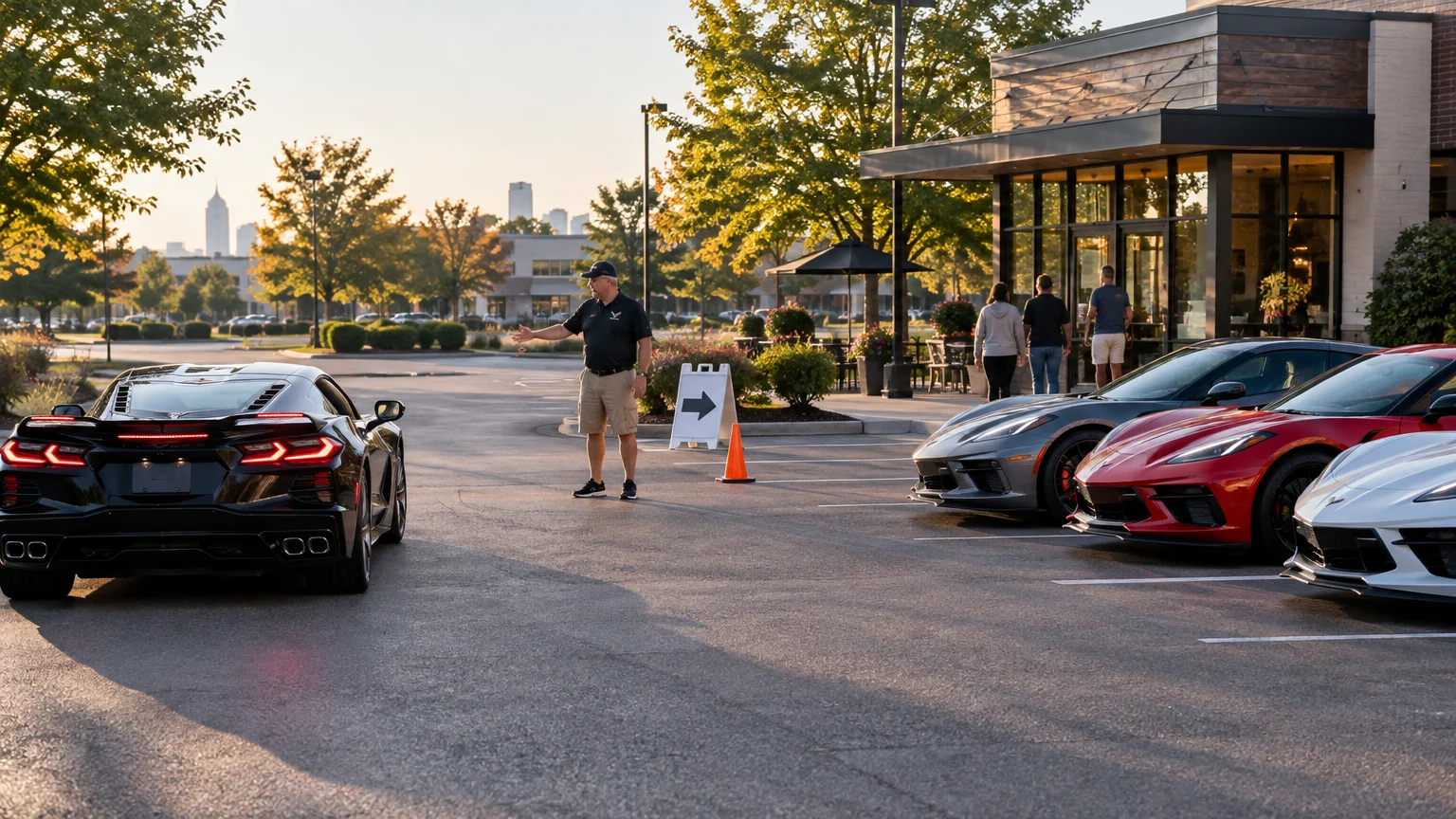
The best Corvette cars-and-coffee feels lively without making the host business regret saying yes. That means getting written permission, setting an attendance limit, protecting spaces for regular customers, and assigning volunteers to guide arrivals. If the lot comfortably holds 30 event cars after customer parking and emergency access are preserved, invite 30—not 50 and a hopeful shrug.
A two-hour gathering is usually enough. People can admire the cars, catch up over coffee, and leave before the event becomes an all-morning parking occupation. The goal is not to pack every striped space with fiberglass. It is to create an easygoing meetup that the venue will happily host again.
Start with the property owner, not the invitation
Talk with the owner or property manager before publishing a date. Explain the expected attendance, operating hours, volunteer plan, parking layout, and whether you intend to use signs, tents, tables, music, food vendors, or donation stations. Ask which spaces must remain available for employees, customers, deliveries, accessible parking, and neighboring tenants.
Do not assume that buying coffee entitles a club to occupy the lot. A business may share its parking with other tenants, operate under lease restrictions, or need access for morning deliveries. Written approval gives everyone the same understanding and helps prevent an enthusiastic member from promising something the property manager never approved.
Public property requires another level of planning. Indy Parks says organized events using or affecting park property, facilities, nearby sidewalks, greenways, or streets generally require a special-event permit. Its application calls for a detailed site or course map and an emergency action plan, and it says applications must be submitted at least 45 days before the event. Approval is not guaranteed. Insurance requirements are determined for the particular event, so confirm the current terms rather than assuming a casual meetup is exempt. Review the Indy Parks special-event application before promoting a park-based gathering.
Calculate the real parking capacity
Count usable spaces with the venue instead of relying on an online aerial image. Remove spaces reserved for regular customers, employees, accessible parking, loading, dumpsters, fire lanes, and safe entrance or exit movement. Then leave a small buffer for late customers and ordinary business traffic.
| Lot consideration | Planning decision |
|---|---|
| Customer and employee parking | Protect these spaces before calculating event capacity. |
| Accessible spaces and access aisles | Keep them open for eligible users; never treat striped access areas as display space. |
| Fire lanes and emergency routes | Keep them unobstructed from setup through departure. |
| Entrances, exits, and drive aisles | Leave enough room for normal two-way movement unless the venue approves another pattern. |
| Corvette display area | Fill only to the agreed attendance cap. |
| Overflow arrivals | Direct them to a pre-approved alternative or tell them the event is full. |
Create a simple map showing the Corvette area, customer parking, pedestrian path, entrance, exit, volunteer positions, and emergency route. Indiana Department of Homeland Security guidance calls for an entry and exit plan that preserves emergency-vehicle access. It also recommends notifying first responders when appropriate, identifying severe-weather shelter locations, planning how attendees will receive alerts, and choosing an accessible first-aid location. Indiana’s community event-planning guidance is a useful checklist even for a modest meetup.
Control arrivals before they reach the lot
The easiest crowd to manage is the one you planned for. Use advance registration when capacity is tight, and make clear that registration reserves one vehicle space rather than a whole row for friends. Give attendees one arrival entrance, a time window, and a firm instruction not to queue on a public road.
Place one volunteer near the entrance and another inside the display area. The first confirms where each driver belongs; the second fills spaces in an orderly sequence. Avoid waving cars across moving traffic or trying to control a public intersection. If your concept requires traffic control outside private property, consult the relevant road authority and qualified local officials.
Once parked, event cars should remain parked until departure. Indiana’s event guidance recommends prohibiting vehicle movement or use within the venue while an event is underway. That is a sensible standard around spectators, children, folding chairs, and drivers looking backward over high Corvette rear quarters.
Set a short code of conduct
Nobody needs a page of legalistic rules taped to the windshield. A concise event notice can cover what matters:
- No burnouts, revving contests, racing, or aggressive departures.
- Observe the posted speed and follow volunteer directions inside the lot.
- Keep fire lanes, accessible spaces, sidewalks, and neighboring property clear.
- Supervise children and pets around moving vehicles.
- Pack out trash and report spills immediately.
- Respect the attendance cap and do not create unauthorized overflow parking.
Put these expectations in the registration confirmation and repeat them during the volunteer briefing. A cheerful reminder at check-in works better than waiting until a driver is entertaining the county with a cold-start concert.
Build a weather and cleanup plan
Choose a clear cancellation threshold and a time for making the call. Lightning, severe storms, flooding, ice, and extreme heat can all turn a casual gathering into a poor decision. Identify the venue’s approved shelter area, but do not claim a coffee shop can shelter 100 attendees unless the venue confirms that capacity.
Bring trash bags, absorbent material for minor automotive drips, basic first-aid supplies, and contact information for the venue representative. Assign volunteers to walk the lot after departure. The cleanest compliment an organizer can receive is that the property looked as though no event had happened.
Keep cruises and fundraising separate from the basic meetup
Adding a drive changes the plan. Give drivers written directions and regroup points rather than expecting a continuous Corvette convoy. Our guide to planning a Corvette club cruise without losing half the group covers that task in more detail. Check the INDOT restrictions and closings page near the event date, and remember that city streets and county roads fall under the relevant local authority when route approval is required.
A road closure is not part of an ordinary cruise. Closing or affecting a state highway can require a closure and detour map, local policing-agency traffic-control documentation, local-government approval, and other permit materials. Do not improvise a rolling roadblock because matching Corvettes look good in formation.
If the gathering benefits a charity, decide whether you are accepting donations, selling merchandise, holding a raffle, or using a professional fundraiser. Those are different activities with different questions. Indiana’s Attorney General says charities using their own bona fide employees or volunteers to solicit funds do not have to register or report those campaigns, while professional fundraising consultants and solicitors face separate registration obligations. Confirm how the rules apply to the particular campaign before collecting money. Indiana’s charitable fundraising guidance is the sensible starting point.
Run a small event well before making it bigger
For a first Corvette cars-and-coffee, I would favor 20 to 30 cars, two arrival volunteers, a clearly marked display section, and a firm two-hour schedule. Use the first gathering to learn how customers move through the property, when deliveries arrive, and where pedestrians naturally walk.
Afterward, ask the venue what worked and what caused friction. If customer access stayed open, the lot remained clean, and departures were calm, you have the foundation for another invitation. That is the real measure of good Corvette cars-and-coffee planning: great cars, friendly conversation, and a host who is pleased to see everyone return.
Frequently Asked Questions
What should an organizer do before announcing a Corvette cars-and-coffee?
Get written approval from the property owner or manager. Confirm the date, hours, attendance cap, parking layout, volunteer plan, signs, vendors, customer spaces, deliveries, and any restrictions affecting neighboring tenants.
How should the attendance limit be calculated?
Count the spaces with the venue, then subtract customer and employee parking, accessible spaces, access aisles, loading areas, fire lanes, and room needed for safe traffic flow. The remaining number—not the lot’s advertised capacity—is your event limit.
How long should a Corvette cars-and-coffee last?
A firm two-hour schedule is usually enough for coffee, conversation, and a proper look at the cars without occupying the property all morning. Make the arrival and departure times clear in every event notice.
How can organizers keep arrivals orderly?
Use advance registration when space is tight, designate one entrance, provide an arrival window, and tell drivers not to queue on a public road. Place one volunteer at the entrance and another in the display area, while preserving emergency-vehicle access.
Does an Indianapolis park meetup require a permit?
Indy Parks says organized events using or affecting park property, facilities, nearby sidewalks, greenways, or streets generally require a special-event permit. Its application requires advance planning materials and says submissions must arrive at least 45 days before the event; approval is not guaranteed.
Should display cars move around during the gathering?
Once parked, event cars should remain parked until departure. Indiana event guidance recommends prohibiting vehicle movement or use within the venue while an event is underway, which is a sensible rule around spectators, children, and folding chairs.