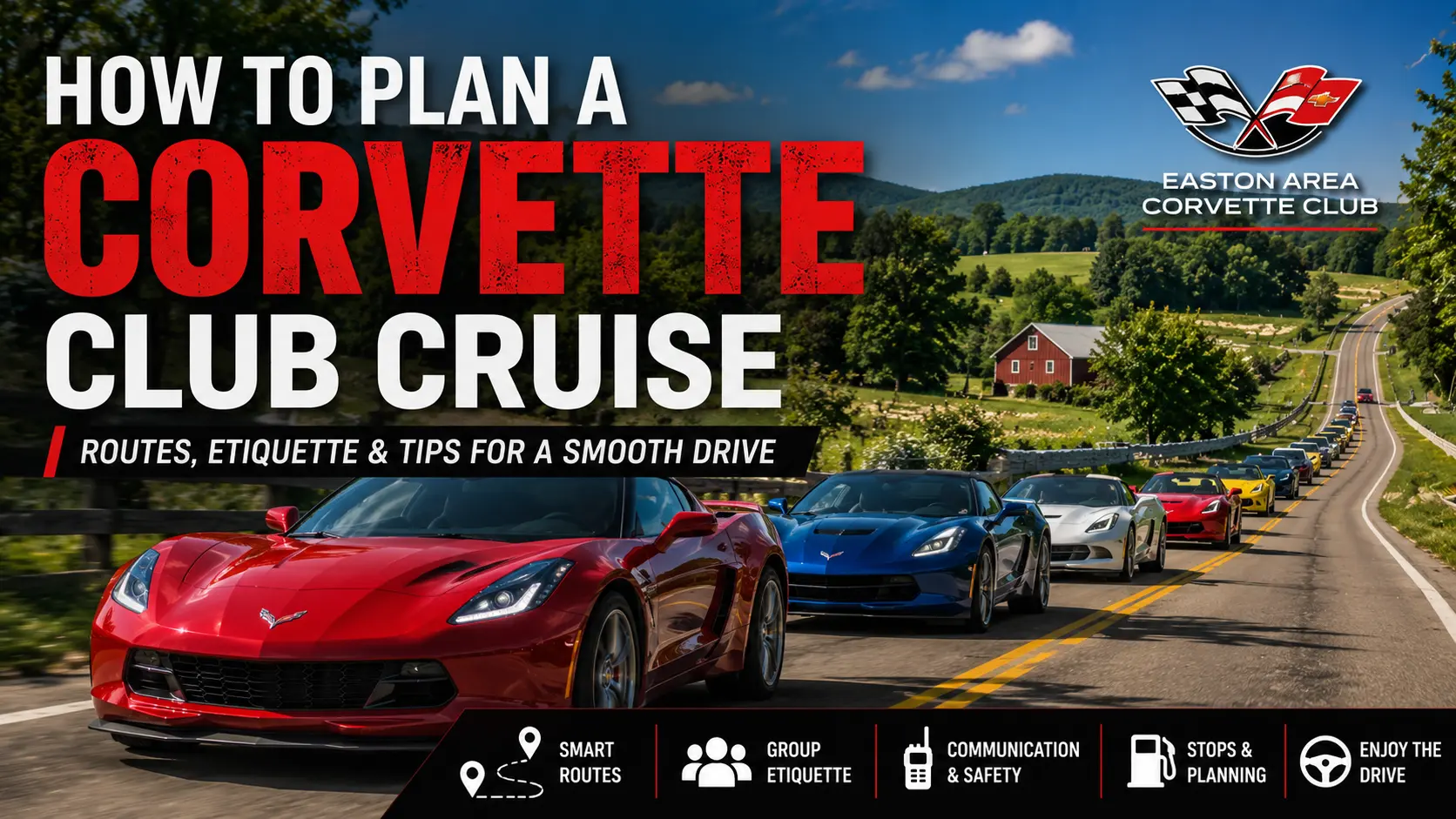
TLDR
- Choose the purpose, approximate group size, and destination before building the route.
- Test-drive the entire route at roughly the same time and day as the planned cruise.
- Assign a lead car and sweep car, but give every driver the full route in case the group separates.
- Use safe regrouping locations instead of expecting drivers to race through lights or catch up.
- Hold a brief driver meeting covering spacing, communication, breakdowns, stops, and weather.
- Treat every participant as an independent driver who must obey traffic laws and make safe decisions.
A row of Corvettes can turn an ordinary Saturday drive into a club event. But it only takes one long traffic light, one missed turn, or one unexpected road closure to spread that row across several miles.
Learning how to plan a Corvette club cruise means accepting that the group will probably separate at some point. The goal is not to keep every Corvette locked into one unbroken line. The goal is to give every driver enough information to reach the next stop safely without speeding, tailgating, blocking traffic, or making a risky maneuver.
Good Corvette cruise planning is less about controlling every car and more about creating a route that still works when normal traffic intervenes.
Decide What Kind of Corvette Cruise You Are Planning
Start with the purpose of the drive. A scenic morning loop requires a different plan than an all-day trip, restaurant cruise, charity event, or caravan to a car show.
A simple event description might read:
A two-hour scenic Corvette cruise starting near Easton, with one planned regrouping stop and lunch at the final destination.
That one sentence establishes the approximate duration, geographic range, number of stops, and need for a restaurant reservation.
Common Corvette club cruise formats include:
| Cruise Format | Typical Structure | Main Planning Concern |
|---|---|---|
| Short social cruise | 45 to 90 minutes of driving | Easy staging and a clear destination |
| Scenic loop | 90 minutes to 3 hours | Road quality, overlooks, and rest stops |
| Restaurant cruise | Direct route with one destination | Parking and meal reservations |
| Mystery cruise | Destination is kept private | Strong route instructions and communication |
| Car-show caravan | Group drive to another event | Arrival time and registration deadlines |
| Full-day trip | Several stops and activities | Fuel, meals, restrooms, and schedule control |
| Overnight trip | Long-distance drive with lodging | Hotel coordination and roadside planning |
Do not make the route longer simply because the organizing committee found another road that looks interesting. A shorter route with good pavement, light traffic, and reliable stops is usually more enjoyable than a complicated route designed to cover as many miles as possible.
How to Plan a Corvette Club Cruise Route
The fastest route is rarely the best group route.
A navigation app may direct one driver through a series of short turns, busy intersections, and tight merges because it saves four minutes. That same route can be difficult for 20 Corvettes to follow.
Look for roads that offer:
- Predictable traffic flow
- Few complicated lane changes
- Limited stop-and-go congestion
- Safe speed limits
- Good pavement
- Clear road signs
- Space for normal traffic to pass or merge
- Fuel and restroom access
- Safe locations for regrouping
- An enjoyable mix of scenery and driving
Corvettes also require a little more attention to the road surface than an ordinary commuter vehicle. During the route test, watch for steep driveway entrances, speed humps, broken pavement, gravel sections, construction plates, deep drainage channels, railroad crossings, and abrupt elevation changes.
A route that works for a newer stock Corvette may still be uncomfortable for a lowered C5, a restored C2, or an older car with a firm suspension and limited cooling capacity.
Drive the Route Before Publishing It
The route organizer should drive the complete route before sending it to participants. Ideally, the test should happen on the same day of the week and around the same time as the actual cruise.
A quiet rural road at 10 a.m. on Tuesday may be backed up near a popular attraction on Saturday afternoon. A restaurant lot that looks empty after lunch may be full when the group plans to arrive.
During the route test, record:
- Actual driving time
- Construction zones
- Fuel stations
- Restrooms
- Rough pavement
- Difficult turns
- Weak cellular service
- Suitable regrouping areas
- Parking capacity at the destination
- Alternate roads in case of a closure
Check the route again shortly before the event. PennDOT’s 511PA service provides current traffic information, roadwork notices, weather conditions, incidents, restrictions, and route alerts.
Choose a Staging Area That Can Handle the Entire Group
The starting location needs more room than the number of registered Corvettes alone would suggest.
Participants will arrive at different times. Some will need to use a restroom, organize belongings, speak with the cruise leader, or adjust navigation settings. Cars also need enough space to form an orderly departure line without blocking customers, driveways, loading areas, or public roads.
A practical staging location should have:
- Permission from the property owner
- A simple entrance and exit
- Enough spaces for all registered vehicles
- Room to line up without blocking parked cars
- Restrooms nearby
- A fuel station on-site or close by
- A visible location for the driver briefing
- Safe access to the first road on the route
Avoid a departure that immediately requires the entire group to make an unprotected left turn across heavy traffic. The cruise can become scattered before it has properly started.
The final destination needs the same level of attention. Call ahead rather than assuming a restaurant, museum, park, or dealership can absorb 20 to 40 sports cars without affecting its normal operations.
Match the Cruise Structure to the Number of Cars
Five Corvettes can usually remain organized with a basic route and one leader. Thirty Corvettes need more structure.
A practical planning framework is:
| Number of Cars | Suggested Structure |
|---|---|
| 5–10 | One lead car and one sweep car |
| 11–20 | Lead, sweep, and a planned midpoint regroup |
| 21–30 | Lead, sweep, midpoint communicator, and multiple regroup points |
| More than 30 | Divide the cruise into smaller groups or “pods” |
For a large event, smaller groups can follow the same route while leaving a few minutes apart. Each group should have its own leader and sweep. Everyone can then gather at a large destination or planned stop.
This approach may not produce one uninterrupted line of Corvettes. That is fine. Smaller groups are easier for traffic to absorb, easier to park, and less likely to pressure drivers into unsafe decisions.
Assign a Lead Car and Sweep Car
A lead car travels at the front. The lead driver knows the route, sets a legal and consistent pace, calls out upcoming turns, and communicates with the sweep car.
The sweep car remains at the rear. The sweep driver monitors the group, reports separations, and assists when someone has a mechanical problem or needs to leave the route.
Car clubs commonly use this lead-and-sweep structure because it creates clear responsibility at both ends of the caravan. Established club guidance also recommends that both drivers know the route and remain in communication.
Do not automatically assign the lead position to the person with the fastest Corvette. The best lead driver is calm, familiar with the route, comfortable maintaining a steady pace, and willing to continue to a safe regrouping point when the caravan separates.
For larger cruises, also assign:
- A route coordinator
- A passenger to handle communication
- A midpoint car with a radio
- An emergency contact who is not driving
- A photographer at planned stops
- A restaurant or destination contact
No participant should attempt to direct public traffic, block an intersection, or hold a lane open for the group. Unless authorized traffic control is in place, every Corvette follows the same rules as every other vehicle.
Give Every Driver the Complete Route
A cruise should not depend on following the taillights of the car ahead.
Each participant should receive the final destination address and every major stop. Drivers should load the route into their navigation systems before departure.
A simple route packet can include:
- Event name and date
- Staging location
- Departure time
- Final destination
- Numbered stops
- Turn-by-turn directions
- Estimated mileage
- Fuel locations
- Restroom locations
- Lead and sweep contact details
- Breakdown procedure
- Weather policy
- Restaurant information
- Planned departure time for the return trip
A digital map link is convenient, but a printed route sheet is still useful. Phones lose service. Batteries die. Navigation apps can also change the route based on traffic and send different cars in different directions.
The route sheet does not need to describe every curve. Focus on important turns, road changes, and stop locations.
Hold a Driver Briefing Before Departure
The driver meeting should be short enough that people listen and complete enough that they know what to do.
Cover the following points:
- Introduce the lead and sweep cars.
- Confirm the first stop and final destination.
- Explain how the group will handle red lights and separation.
- Review the expected pace and following distance.
- Confirm the communication method.
- Explain the breakdown procedure.
- Identify planned fuel and restroom stops.
- Review the weather plan.
- Remind drivers not to block intersections or prevent other cars from merging.
- Confirm the rollout time.
A briefing might sound like this:
We will leave at 9 a.m. The red C7 is leading, and the blue C5 is sweeping. Everyone should have the first stop loaded into GPS. Stop normally at all lights and signs. Do not speed to catch the group. If we become separated, continue to the marked regrouping lot. If your car develops a problem, notify the sweep. The rest of the group will continue to the next safe stop.
That takes less than two minutes to say. It also answers most of the questions that cause confusion once the cars are moving.
Use Safe Corvette Caravan Etiquette
Traditional caravan advice sometimes focuses on keeping the line together at all costs. That should not be the goal.
The safer approach is to treat the caravan as a group of independent drivers following the same plan.
Leave Enough Following Distance
A Corvette cruise should not look like a line of cars drafting on a racetrack.
PennDOT recommends a minimum four-second following distance on dry pavement. More space is needed on wet roads, downhill grades, poor surfaces, or anywhere visibility is limited.
To check the gap, watch the car ahead pass a sign, pole, or pavement marking. Count four seconds. If your Corvette reaches the same point before the count ends, increase the distance.
Fixed advice such as “stay three car lengths back” becomes less useful as speed increases. A time-based gap adjusts with the speed of traffic.
Allow Other Traffic Into the Group
Do not close gaps to prevent another vehicle from merging into the caravan. Other drivers may need to enter, exit, or change lanes.
Let them in. The Corvette ahead will still be visible, and every participant should already know the route.
Stop at Red Lights
A participant who reaches a yellow or red light should stop normally. The lead group should continue to the next planned regrouping location.
No cruise is improved by someone entering an intersection late because they are afraid of losing sight of the car ahead.
Do Not Race to Catch Up
When a group separates, the cars behind should follow the route at a normal pace. The leader can wait at the next safe stop.
A plan that requires drivers to exceed the speed limit to rejoin the group is not a workable plan.
Maintain Your Position When Practical
Frequent passing and position changes create unnecessary movement. Drivers should generally remain in order unless instructed otherwise or required by traffic.
But maintaining position is not more important than making a safe lane change or allowing another motorist to merge.
Plan Communication Without Distracting Drivers
Two-way radios can be useful for calling out turns, hazards, missed exits, or mechanical problems. They can also become distracting when everyone talks at once.
Keep communication brief:
- “Turning right in one mile.”
- “Group split at the light.”
- “Sweep is with the disabled car.”
- “Road debris in the right lane.”
- “Proceed to Stop Two.”
A passenger should handle the radio or phone whenever possible. Set the navigation system, radio channel, and audio level before departure.
As of September 2026, Pennsylvania law prohibits drivers from holding or supporting an interactive mobile device while driving, including while temporarily stopped in traffic or at a red light. Citation enforcement began in June 2026. Hands-free functions remain available, but drivers should pull safely off the road when more involved communication is necessary.
A group text can still be useful before departure and while parked. It should not become a live conversation among drivers on the road.
Require Basic Vehicle Preparation
The organizer does not need to inspect every Corvette. Participants should still receive a pre-cruise checklist.
At a minimum, owners should check:
- Tire pressure when the tires are cold
- Tread and sidewall condition
- Engine oil and other fluids
- Brakes
- Battery condition
- Headlights and brake lights
- Turn signals and hazard lights
- Windshield wipers
- Fuel level
- Roadside-assistance information
Owners should also know what their Corvette carries for a tire problem. Depending on the year and equipment, that may include run-flat tires, a mobility kit, an inflator, sealant, or a spare. Finding that out on the shoulder of the road is poor timing.
NHTSA recommends checking road conditions before departure and carrying an emergency kit with items such as a charger, first-aid supplies, flashlight, warning devices, jumper cables, pressure gauge, basic tools, water, food, medicines, and maps.
For a club cruise, the lead or sweep car can carry a more complete shared kit. That does not replace the need for each owner to understand their own vehicle.
Create a Clear Breakdown Procedure
When one Corvette stops, the entire caravan should not crowd onto the shoulder.
A safer procedure is:
- The affected driver moves to a safe location when possible.
- The driver contacts the sweep car.
- The sweep remains with the affected vehicle.
- The rest of the group continues to the next planned stop.
- The sweep reports whether the car can rejoin, needs roadside assistance, or is leaving the event.
This reduces the number of people exposed to passing traffic. It also keeps the disabled vehicle from being surrounded by cars that make it harder for a tow truck or emergency vehicle to reach the scene.
For a collision, medical emergency, smoke, fire, or unsafe roadside location, contact emergency services first. Club logistics come second.
The route packet should include the address of the next stop so the sweep and affected driver can rejoin later without trying to chase the moving group.
Build Stops Into the Schedule
Breaks are not evidence that the route is too easy. They give drivers time to regroup, use restrooms, check the cars, and speak with the organizer.
For most social cruises, a planned stop after roughly an hour to 90 minutes of driving is reasonable. Longer routes may need more frequent stops depending on the group, traffic, weather, and age of the vehicles.
Choose stops with:
- A safe entrance
- Enough parking
- Restrooms
- Fuel nearby
- A clear exit
- Space that will not interfere with another business
- Permission when the group is large
Avoid stopping on highway shoulders, narrow roads, private driveways, or small lots that cannot hold the entire group.
A sample schedule could look like this:
| Time | Activity |
|---|---|
| 8:00 a.m. | Staging opens |
| 8:20 a.m. | Driver briefing |
| 8:30 a.m. | Cruise departs |
| 9:20 a.m. | Planned regroup and restroom stop |
| 9:40 a.m. | Cruise resumes |
| 10:30 a.m. | Arrive at destination |
| Noon | Lunch or scheduled activity |
| 1:30 p.m. | Optional group return |
Publish an expected end time. Some members may want to participate in the drive but make their own plans afterward.
Make the Cruise Feel Like a Club Event
A route and a meeting time are enough to create a drive. A few thoughtful details can make it feel like a recurring club tradition.
The welcome packet might include:
- Printed route card
- Windshield-safe event card
- Emergency contact sheet
- Restaurant voucher
- Club calendar
- Small annual cruise sticker
A dated sticker with the route name, club name, or featured Corvette generation gives participants a simple keepsake. CustomStickers.com offers custom vinyl stickers in different shapes and sizes, along with an online proof that lets the organizer review the artwork and cut line before printing.
Hand stickers out loose. Do not place anything directly on an owner’s paint, glass, dashboard, or interior trim. Each owner can decide whether to use the sticker on a cooler, garage cabinet, route binder, laptop, water bottle, trailer box, or another suitable surface.
For cruises connected to a car show, the site’s existing dash-plaque guide also explains how to create collectible participant pieces without overcrowding them with temporary event details.
Set a Weather and Cancellation Policy
A light rain shower may be acceptable for some groups and a reason to stay home for owners of restored cars. Those are personal decisions.
The organizer should focus on conditions that affect safety:
- Severe thunderstorm warnings
- Flooded roads
- Ice or snow
- Poor visibility
- High winds
- Dangerous heat
- Road closures
- Standing water
- Fallen branches or storm debris
State the policy when the cruise is announced. Include the time when the final decision will be made and where the update will appear.
Do not make participants check five social pages, three text threads, and an email inbox to determine whether the event is still happening. Use one official communication channel.
Common Corvette Cruise Planning Mistakes
Building the Route Only in a Navigation App
A map does not show every steep entrance, pothole, crowded parking lot, or awkward intersection. Drive the route first.
Trying to Keep the Caravan Together at Any Cost
Traffic lights and merging vehicles will divide the group. Safe regrouping is better than aggressive catch-up driving.
Choosing a Small Starting Lot
The staging area needs room for parked cars, late arrivals, a briefing, and an orderly departure line.
Failing to Share the Final Destination
Mystery cruises can still give participants sealed or digital emergency destination information. No one should be completely dependent on the car ahead.
Letting Everyone Use a Different Route
Navigation apps may select different roads. Share the same planned stops and review the main route before leaving.
Having the Entire Group Stop for One Breakdown
The sweep car should assist while the rest of the group proceeds to a safe location.
Treating the Schedule as Exact to the Minute
Traffic will change the timing. Build some flexibility into reservations and arrival estimates.
Forgetting the Return Plan
Some drivers will return with the group. Others will leave independently. Make both options clear.
FAQs
How Many Cars Are Too Many for One Corvette Caravan?
Once a group grows beyond roughly 20 to 30 cars, dividing it into smaller groups usually makes the drive easier to manage. The right cutoff depends on the roads, parking areas, number of leaders, and planned stops.
Should Every Driver Use GPS During the Cruise?
Yes. Every driver should have the next stop or final destination loaded before departure, even when printed directions are also provided. GPS is a backup to the group, not a replacement for route planning.
What Does the Sweep Car Do?
The sweep car stays at the rear, communicates the group’s status to the leader, and assists a participant who has a breakdown or leaves the route. The sweep should know the full route and every stop.
How Far Apart Should Corvettes Drive?
PennDOT recommends at least a four-second following distance on dry pavement. Increase that distance in rain, poor visibility, heavy traffic, or other difficult conditions.
Do Corvette Club Cruises Need Two-Way Radios?
No. A small group can operate with a shared route, phone contacts, and planned stops. Radios become more useful as the group grows, but they should be set up before departure and handled by a passenger when possible.
Should a Corvette Cruise Be Canceled Because of Rain?
Not automatically. The organizer should evaluate visibility, flooding, road condition, severe-weather alerts, and the safety of the planned route. Individual owners can still decide not to expose their cars to rain.
Conclusion
The best Corvette club cruises do not depend on everyone staying bumper-to-bumper from the first parking lot to the final destination.
They use a tested route, a suitable staging area, clear lead and sweep roles, safe regrouping locations, and directions that every driver can follow independently. Participants know what happens when traffic splits the group, when a car breaks down, or when weather changes the plan.
That is the central lesson in how to plan a Corvette club cruise: design the event around normal traffic rather than fighting it. The Corvettes may arrive a few minutes apart. The important part is that the owners arrive safely and enjoy the drive.
